OPEN ASSEMBLY
Experiments in Aesthetics and Politics
















Who is the Man on the Street?
@subwaytakes brings celebrities down to earth (literally), interviewing them in the United States’ largest public transit system.
The Zohran Mamdani mayoral campaign was heralded for its use of street aesthetics; so much so that his rival, Andrew Cuomo, attempted to copy Mamdani’s street-easy demeanor on social media.
Of the ten thousand talking heads droning at us from the ten thousand screens, no one is more recognizable than the man on the street. You know him from the local news, standing in front of a local grocery store, a courthouse, or a metro hub, dressed for the weather. He’s Joe Citizen, she’s Jane Doe— more or less eccentric but always keeping it real. Despite the ever-present microphone, we do not need to hear a man on the street to recognize him; he is always (obviously) on the street, and his microphone is always in someone else’s hands.
You can catch him in short-form videos on platforms like Instagram and TikTok, and he is experiencing something of a renaissance. On the streets of the metropole today, influencers wielding smartphones hunt unsuspecting strangers in search of an interview. People walking down High Street must stay on High Alert, lest someone hurl an inane question like “what are you listening to?” their way, hoping to catch a reaction. One can’t step foot inside a commercial district or a city park without being accosted.
“What are you listening to?” is one of the most common formats for street interviews. The form relies on spontaneity, documenting the random pedestrian’s listening habits.
Perhaps you yourself have been a man on the street. I remember being a child, playing in a fountain at the Seattle Center while a journalist asked my father his opinion on the War in Iraq. There was a whole team, someone manning a camera, another on a boom mic. I don’t remember my father’s answer, but I do remember us gathering around the TV as a family later that night. More recently, in West Hollywood, I was asked my contraceptive preference by a man wielding an iPhone (I declined to answer). That experience was different— I did not realize the man was recording me until after he asked me his question. There is a strange feeling I get in public nowadays that we are all, in some sense, always at risk of becoming the man on the street with the swipe of a thumb.
And this is the point, isn’t it? To capture a person in their “natural habitat,” to make one believe that a shared environment means— what exactly? — that they exist in the real world, a shared world? And that this real, shared world lends credence to the things we say and believe?
As quickly as this new social media form has proliferated, it has just as quickly become threatened, like many mediums, by Artificial Intelligence. AI can generate not only dialogue but also incredibly lifelike images of interviewers, interviewees, and the streets they walk. The real world is no longer legible— the “reality” that once lent interviews their validity is quickly disappearing from our screen-world altogether.
As realistic as AI has gotten, it still can’t pronounce “St. Tropez.”
Which leads us to the question: can we still trust the opinions and dispositions touted by the interview form? Could we ever, really?
The Dialogue
GORGIAS: What do you mean, Socrates?
SOCRATES: I mean that he has not exactly answered the question which he was asked.
GORGIAS: Then why not ask him yourself?
SOCRATES: But I would much rather ask you, if you are disposed to answer: for I see, from the few words which Polus has uttered, that he has attended more to the art which is called rhetoric than to dialectic.
Gorgias, Plato, Project Gutenberg
The earliest “interviews” come to us from the Socratic Dialogues. While it is impossible to know why Plato recorded his philosophy in dialogue form, we read in Gorgias about a distinction between “rhetoric” and “dialectic.” The dialogue between Socrates and the rhetorician Gorgias seeks to uncover the nature of rhetoric— Socrates grills Gorgias as well as any persistent interviewer. Of course, it is through this interview that the dialectic method is performed— the call and response, so to speak, of two interlocutors attempting to arrive at truth, and when Gorgias cannot provide a satisfactory answer to any of Socrates’ questions, Socrates gives his own examples of dialectic, preferring them to Gorgias’ flowery speech. Eventually, Socrates dismisses the ability of rhetoric and speech-giving to tell the truth. Rhetoric is only a method of persuading one to your opinion, which may be right or wrong. Truth— the real truth— only reveals itself through reason. And reason, apparently, is only possible if we are allowed to openly question a rhetorical claim and to hear our question acknowledged and answered. This is what we are led to believe via the dialogue’s Q&A-style questioning. Today, we refer to this dialectical questioning as the Socratic Method. It reveals a kind of dialectical truth that we are meant to believe is truer than mere rhetoric.
Also of note is this dialogue’s mise-en-scène; it begins at the exterior of the house of Callicles in Athens. Socrates must step inside the private home to pose his questions to Gorgias— he quite literally leaves the street to meet the rhetorician, a move notable, as Socrates was known to host his dialogues in public. But perhaps more importantly, the mention of the mise-en-scène within the dialogue gives it a sense of place, by which I mean a sense that a “third” person is observing. The exteriority of the scene implies objectivity; there is now an audience who can see the scene laid before them and judge the arguments accordingly. The questions (and their answers) seem “real,” as if they “really happened,” because we are meant to imagine them being said at a specific time and place. A reader of the dialogue can pretend to be a bystander, unaddressed. Unlike an essay or speech, which is addressed directly to us and can be adjusted to the rhetorician’s aims, the dialogue is set and factual because it does not involve us, thereby removing us from the aims of rhetorical motivation. The truth portrayed in the dialogue is uncorrupted because it does not involve an outside agent— us— as interference. This is a different kind of truth; I’ll call it documentary truth. It is similar to the sort of truth that underlies our modern notion of history. It claims a specific when and where that lends almost archival validity to the dialogue’s content.
But of course, this is an illusion. We are addressed by Plato, and the dialogue is a work of fiction. And perhaps by Socrates’ definition, the dialogue is an advanced type of rhetoric, even more deceitful since it pretends to have this type of objectivity when it, in fact, does not. The real dialogue is not between Socrates and Gorgias (did they really exist?) but between us and Plato— we should therefore ask ourselves what Plato’s aim is in divulging this fiction to us.
All this to say, there is an inherent (but illusory) trust in the dialogue as form. Not only are we led to believe that 1) dialectic itself is a more valid way of truth-seeking than pure rhetoric, but 2) the document of this dialectic professes something of the real, even if it is only mimesis, by claiming to be a transcription of words actually spoken. The irony between the two lies in the fact that dialectical truth claims a sort of truth-as-concept, where the documentary truth is a truth-as-event. These two truths do not necessarily validate one another. After all, someone may lie, or hold an incorrect opinion, and a document recording that lie would constitute documentary truth: yes, that person did lie here.
Definitions
Of course, none of the Socratic Dialogues are interviews, not really. We know that interviews are meant to be factual— the Socratic Dialogues make no such claim. We also expect the interview to be a bit one-sided; interviews are never a true dialogue. In her list of tentative definitions of interviews, Communications scholar Paata Natsvlishvili distinguishes between the two interlocutors of an interview: “one party— the respondent or the interviewee, is the possessor and source of some definite information; the other— the journalist or the interviewer— is the receiver and disseminator of this information.” This makes the interview different than a true dialogue, in which people of equal footing exchange words. In the interview, there is clearly a mediator (the interviewer) who facilitates the exchange of information from the interviewee to the audience. The mediator must stick to this role— as Natsvishvili emphasizes, interviews “exclude discussion.” This disbars a host of other forms, including the contemporary podcast, the presidential debate, and the two-hander play.
“The interview,” she goes on, “unlike all other journalistic genres, serves to show the opinion of the respondents but not of the journalists themselves.” Of course, what is notable in this definition is the admission that most journalism is couched in the subjectivity of the journalist— that, by filtering information through a reporter, we understand it to be somehow corrupted or manipulated by the press. The interview, then, bypasses this editorializing.
Finally, and perhaps most interesting, Natsvlishvili notes that interviews must be broadcast soon; the interval between interview and publication must be “as short as possible.” This specification implies that interviews are not evergreen. Their validity depends upon the timestamp, and what is said at one time may not be true at another. I notice this the most when I watch old Barbara Walters interviews, the queen of the “gotcha” moment. Her interviewees often retract statements after the fact; the interview is only “correct” in a short interval after they are aired. I think of Monica Lewinsky taking responsibility for her affair with President Bill Clinton in an interview conducted by a berating Walters in 1999. By today’s account, Lewinsky has admitted that she was not in a position to consent to the President. Thus, the record is often adjusted afterward— either because culture shifts, or because we learn something new. The interview is never up-to-date. [See also: Michael Schudson, “Question Authority: A History of the News Interview in American Journalism, 1860s–1930s,” in The Power of News (Cambridge, MA: Harvard University Press, 1995), 84.]
The Barbara Walters interview of Monica Lewinsky had 70 million viewers, according to the New York Times, making it one of the most-watched television interviews of all time.
The Interview
As ubiquitous as the street interview is today, the interview form in general is relatively new— at least in the field of journalism. News historian Michael Schudson traces the journalistic interview to 1836 (or perhaps even later, in 1859) and labels it a particularly American phenomenon “especially suited to a democratic society.” In the latter half of the 19th century, journalists in the United States began to cultivate what then seemed a uniquely privileged position— they were not only able to question power directly, but also to expect an answer. According to Schudson, the interview became firmly entrenched in American journalistic practice when President Andrew Johnson “submitted” to an interview in 1868. It may be that the press enjoyed a unique amount of leverage in the American political system, a kind of leverage made possible by print’s influence on the electoral system.
Before this, the direct questioning of power was not done in public— journalists may have questioned power behind closed doors, but that power (presidential, royal, papal, administrative, artistic) was never quoted directly. Journalists were even discouraged from taking notes. This is because the press, as an estate, had traditionally served as a mouthpiece to power, not a fact-checker of it. Editors heavily influenced the stories of their writers, and a story that did not quote, but rather relayed, was much more pliable under an editor’s gaze.
So the interview upset this power relationship in two ways: by quoting power directly, it did not (supposedly) allow for editorial adjustment (after all, those were the president’s exact words), thereby shifting power away from editorial teams to reporters themselves. Additionally, it changed the relationship between those in power and the readers of the newspaper— suddenly, the layman (if he was literate) could hear for himself what his Senator had to say, and could change (if he enjoyed suffrage) his vote accordingly. This was not so in the monarchies of Europe, which abhorred the interview as a particularly American blight.
The scandal of the interview process was as scandalous as the idea of democracy itself. Schudson remarks that the interview heralded a new sort of relationship of the press to the world, one of “impersonal surveillance.” (Schudson, 84) It created a world in which the powerful were always watched for the sake of being watched— or, in other words, the new press existed to convey neutral, impersonal information to the public. Public figures became truly public through publishing and publicity, and this was seen as a service to liberal democracy, which thrived (in theory) with a mature and educated people.
Vox Populi, Vox Dei
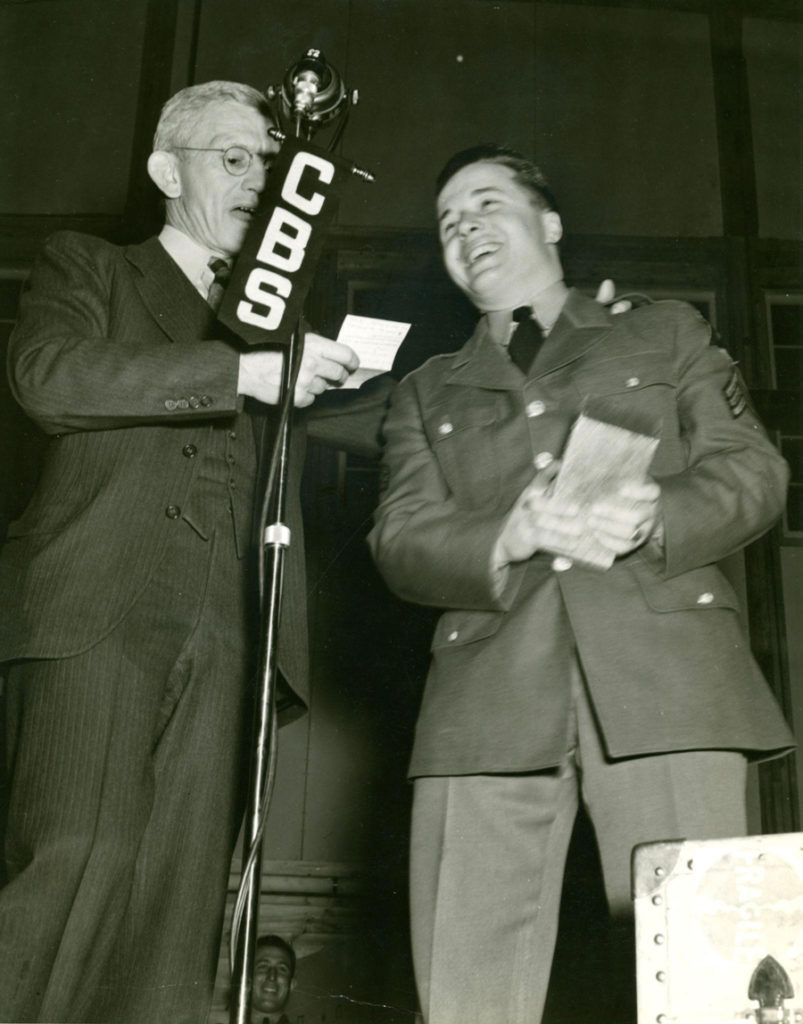
Sgt. John L. Berlew holds a gold brick during his interview with Parks Johnson. Fort Knox, Kentucky, March 23, 1942. From the Parks Johnson Collection at the University of Maryland.
Until the advent of radio and television, interviews were still a print phenomenon, which meant that they could always be edited (even if they posed otherwise). The shift of news to the airwaves would eventually change this. Vox Pop, a radio program broadcast from Houston and later New York City from 1932 until 1948, introduced a radically different interview format. Hosted by Parks Johnson and a rotating cast of co-hosts, the program featured interviews with Americans on the street, in hotel lobbies, in wartime factories, at festivals— anywhere the “typical American” could be found.
This was a notable shift in two ways: first, it used spontaneous, unscripted interviews, which had previously been rare on radio programs. While the program still maintained editorial power in its interview selection (just as newspapers retained some editorial power in print), the interviews themselves could not be greatly altered. They were “authentic” (straight from the horse’s mouth!), more authentic than a print interview could ever hope to be. This authenticity was, of course, always mere appearance. Who was selected for interviews and which interviews aired was always muddied by editorial interference.
Second, it shifted the interview format’s focus away from the senator and the candidate to the milkman and the riveter. The layman, who had considerably less to lose than his senator, could speak freely about the events of the day without fear of political or monetary retribution. This, too, bolstered the program’s authenticity, which cannot be overstated. The show’s title, Vox Pop, is an abbreviation of the Latin Vox Populi, Vox Dei: the voice of the people is the voice of God. The man on the street— spontaneous, unscripted, uncorrupted— had become a source of a kind of truth, by nature of his class. It did not matter that he had hardly time to think of his answers, nor that he lacked expertise; the dialectic of the interview, and the snapshot of him at a particular time and a particular place, was enough to endow him with (an admittedly tongue-in-cheek) holy authority. This authority was so recognized that the “VoxPop” became the industry term for man-on-the-street interviews throughout radio and television newsrooms. The term is still used in the industry today.
Some Vox Pop episodes from 1940. As with today’s street interviews, advertising is a prominent feature.
But Vox Populi was, in a way, a source of a kind of truth, insofar as it documented the opinions of people at a certain place at a certain time. Whether or not the opinions were correct or well-analyzed is beside the point. Because of the limited form of the interviews themselves (their brevity, their mediation through an interviewer, the types of questions asked), we cannot ever really claim to know if the man on the street even believed what he was recorded as saying. All we can really know is that a person said this thing at this time, which is a kind of truth, the documentary kind of truth. But here is the essential point— we should not confuse the documentary effect of radio (and later television) with the dialectical Truth with a capital T. An opinion at a given point in time may always be changed by persuasion, as Socrates has already warned us. It may be true that a riveter once said, “If you want to be an effeminate woman, you should have long hair, but if you want to be a modern woman, you should have short hair.” But is what she said true?
Billy on the Street
Billy Eichner verbally accosts New Yorkers in public.
“Name a woman!” screams Billy Eichner into his microphone, accosting a woman with a yoga mat. The woman, clearly distressed, replies, “Name a woman?”
Billy on The Street, a television game show which aired intermittently between 2011 and 2016, is a street-interview show gone wild; often running (and screaming) through the streets of Manhattan, Eichner accosts passers-by with inane questions like “Does ‘from sea to shining’ sea include Tara Reed?” or “Are you jealous of Beyoncé’s success?” Startled, most people can’t answer basic questions. One man, when asked to name a movie, replies, “Radio Shack.” Another, when asked to name a white person, replies “Michael Jackson.”
Billy on the Street turns the street interview format on its head. The dialogue is often aggressive, and the questions are extremely niche or without context. The effect is an absurd exercise in the media’s confrontation with the public, wherein the seams between the reality of the street and the pastiche of the camera are on full display. Often, we see people waiting for the bus or a walk sign, suddenly pulled out of their day-to-day and thrust into frame. This leaves no time to adapt to being recorded, no time to gather thoughts, and hardly any time to curate a sense of sociality.
The authenticity here lies not in the opinions or statements of the interviewees, but rather in their raw bodily reactions to being accosted by a television camera. The verbal responses of these (wo)men-on-the-street are secondary to their physical responses, bewildered faces, their shrieks, or their sudden flights from the sidewalk. Rhetoric is gone; the truth lies only in the documentation, and we therefore cannot confuse the content of their words with the truth of the recorded image.
Hollywood tourists are asked misleading questions for “Jimmy Kimmel Live!” When asked who she’d like to see sign the newly minted Declaration of Independence, one woman answers, “Beyonce.”
In this way, Billy on the Street is the most honest of comedy street interviews. Across the continent, in Hollywood, Jimmy Kimmel Live! employs a rather different technique. In these interviews, people are not accosted— instead, they are asked a series of misleading questions, such as “We’re talking to people about some of the current events that are going on right now. Would you like to congratulate Amelia Earhart on becoming the first female pilot to go transatlantic?” The interviewees then answer the questions as if the information presented to them is a fact when, of course, it isn’t.
These questions, designed to elicit an uninformed reaction, certainly undermine the notion of Vox Populi, Vox Dei, but is it valid? After all, the questions are designed to entrap, taking advantage of a person’s trust in the media in order to humiliate them. On the other hand, many of these questions seem basic, obviously false; the comedy lies in the street-person’s inability to discern basic fact from fiction.
Jordan Klepper interviews members of the MAGAverse.
Jordan Klepper’s segment on The Daily Show makes similar use of the man-on-the-street interview, but without the entrapment. In his interviews of MAGA supporters in the “MAGAverse,” he records his interviewees touting conspiracy theories without much effort to correct them. “Biden is a pedophile,” spouts one woman at a rally for Trump’s inauguration. “He likes to sniff kids.” These interviews employ not entrapment but rather the use of statements so absurd that they must be untrue.
What these comedians reveal about the man on the street is that he is not to be trusted. No longer are we listening to interviews in good faith— nor should any of us street people trust an interviewer to be looking for the truth. The street, it turns out, is a chaotic place with uninformed people; it can no longer hold any sort of dialectical truth. What remains, still, is the truth-of-place, the sense that we are neutral observers to a conversation, that strange truth of the documentary that tells us— what? That someone said an absurd something at a here-and-now which could change at the next there-and-later.
Death of the Interview?
Are You Okay?” uses the interview form to sell BANG energy drinks.
But we no longer need to rely on journalists, radio show hosts, or even comedians to conduct a street interview. The advent of the iPhone, along with the proliferation of monetized short-form videos, allows almost anyone to begin conducting their own interviews. I might take my phone and head out to the Americana, or the Strip, and start asking people about their favorite movies— or something more personal, like their contraceptive choice. And I can do this with almost no training whatsoever, and no editor to question my motives, except perhaps the unreliable content filters and algorithms of the platforms on which I post.
This is the logical conclusion of what was once touted as journalism’s most democratic form. We have managed to remove, even, the journalist (or perhaps we are all journalists?) Does this offer revolutionary potential, in which regular, even marginalized people can engage in a dialectic with one another? The thought is a hopeful one, but the reality is that the people making these videos often have no greater mission than to drive views, likes, and revenue. The price we pay for this capitalist democracy is that we are now all surveilled, monitored for our views, and then sold to tech companies. The democratic potential of the iPhone street interview seems not very democratic at all. It is often sold for blatant self-promotion, data farming, and advertising; its purpose is to generate capital. It does not pretend to do anything more noble than that.
Still, we wonder: what is so entertaining about these street interviews? From a purely aesthetic standpoint, the street interview is unique and recognizable in its form. We instantly know we are watching a street interview, even with the audio off— the microphone in front of someone’s face, the movement of the phone camera, their place between brownstones or at the park. The form is recognizable enough to interrupt an otherwise erratic scroll through short-form videos. We may even recognize where the street interview is taking place or at least make an attempt to locate it. Oh, look, it’s the Tesla Diner! Oh, she’s in front of my CVS! I ride MUNA! I take the Metro-North! It is this visual hook that keeps us invested in the interview, and the feeling that the person being interviewed is in the world, is not separate from us. The parasocial relationship between a person in a street interview is different from our typical relationship with a celebrity and their influence. We might run into this person in the checkout line. It does not matter if we ever do, if they are who they say they are, or if they even exist—the visual urban hook is enough. And, in the world of short-form video scrolls, even a second of attention is enough to generate value for the video creator.
Fake Streets
@joeyonthestreets creates entirely AI-generated street interviews. Who is Joey? Is he based on a real person? Does it matter?
This is nowhere more exemplified than in the newest form: the AI interview, wherein generated interviewers interview fake people on fabricated streets. In these interviews, the form is completely hollowed out. We recognize it as an interview—all the cues are there—but it no longer serves any truthful function; not even that of the most basic truth —the document —which at least admits that someone was somewhere at some time. No, neither the dialectical nor the documentary truth exists in these AI interviews; the irony between the dialectical truth and the documentary truth has been resolved by pure negation. There is no longer a dialectical truth (the dialogue is meant to sell likes, not generate dialogue) nor a documentary truth (the then-and-there is fake, too). The only “truth” we can salvage from these types of AI videos is purely aesthetic— we saw the video; it exists. This is a kind of solipsistic truth, where the only thing we can know to be true is our unmediated experience. Still, the form persists, a pure reaction to the vestige of our attention-giving habits.
What, then, must we do about our dearly departed form? Should we, like Plato, disavow the truth in any kind of art and rhetoric, clean our hands of the whole enterprise, say to hell with it! Are we to throw away the interview in particular, or perhaps journalism in general, in favor of what we can know by our own eyes and ears? We might be hypocrites to dismiss all artificiality. After all, Socrates never recorded his own dialogues; Plato, perhaps the most masterful of all Rhetoricians Against Rhetoric, recorded them– and likely made them up. In a way, the artificiality of the Platonic dialogue– as far as the mise-en-scène is concerned– is no different than videos created by artificial intelligence. Imagine, if you will, an AI video of the dialogue between Socrates and Gorgias. Keep the dialogue exactly the same (you can use a translation or the Greek); the argument remains coherent, even if the scene is out of context. If there is a Truth, like Socrates claims there is, it may be preserved in the dialectic, even if the documentary truth is completely absent. In fact, this is true of the original text of the dialogue; we can never know whether it recorded a real time or place; we can only follow its dialectical argument. All of the Socratic dialogues are ancient simulations, aren’t they?
A street interview I created with Sora2. The dialogue is lifted from Benjamin Jowett’s translation of Gorgias.
So we are not resigned to solipsism, not completely; that would be as absurd as losing trust in all text just because we found out that Shakespeare may have been multiple authors. Humans have long wielded simulation and artificiality to communicate. True, we may no longer know who said something or where they said it, but we can still glean information from what is being said. As AI-generated content becomes indiscernible from the real, we will have to relearn how to use the internet as a space for fiction. In fiction, there is no appeal to authority, no citing of trusted sources, no precedent for empirical evidence; there is just simulation, from which there is still much to learn. We must learn to read the internet as if it were a novel, a place of pure hypothetical.
Still, the empirical documentary truth is useful; and for that, we may have to take a page out of Socrates’ (or is it Plato’s?) book; instead of relying on the simulation for our news, we must rely on our own senses– to live as he did, in a real, unscripted, dialogic and documentary truth, would mean getting off the screen and into public, speaking with our neighbors who we can verify with our ears and voices and bodies, and understanding that truth, if it is anywhere, was never just in the airwaves or the print page or the telephone screen, but also somewhere on the street.