OPEN ASSEMBLY
Experiments in Aesthetics and Politics

















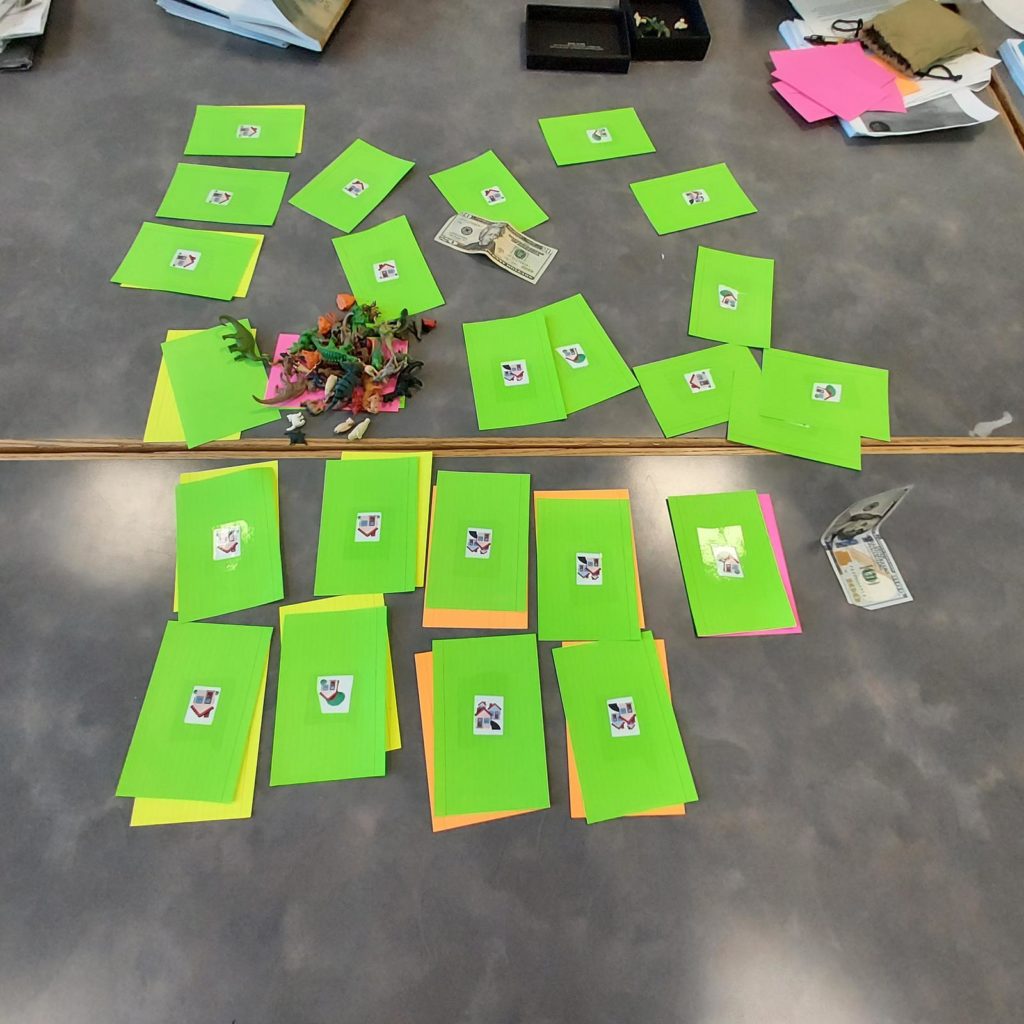
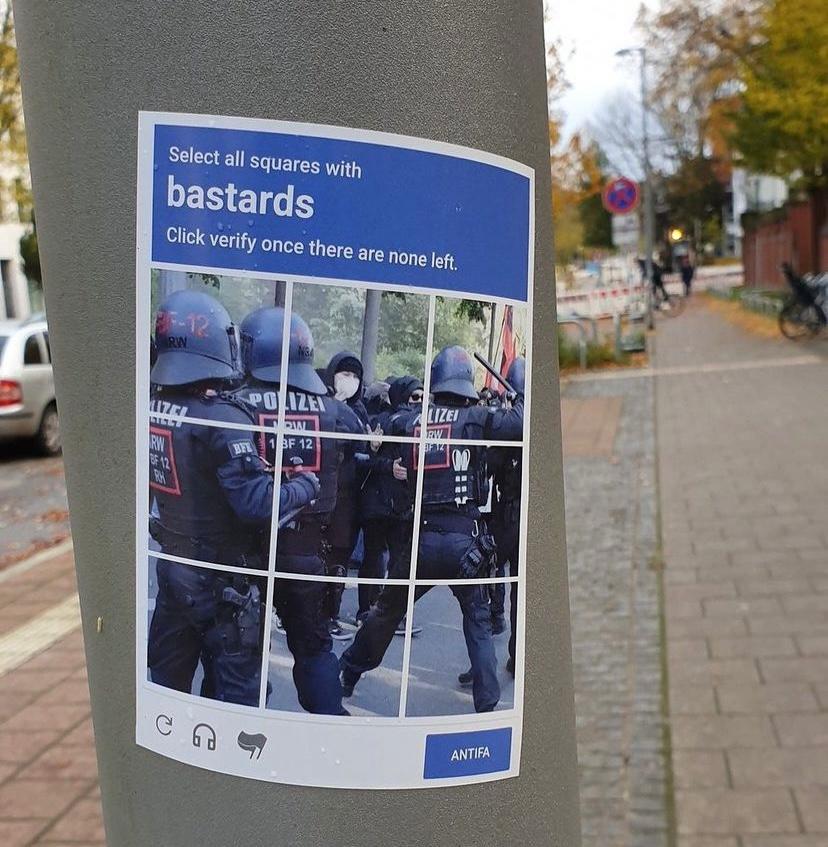
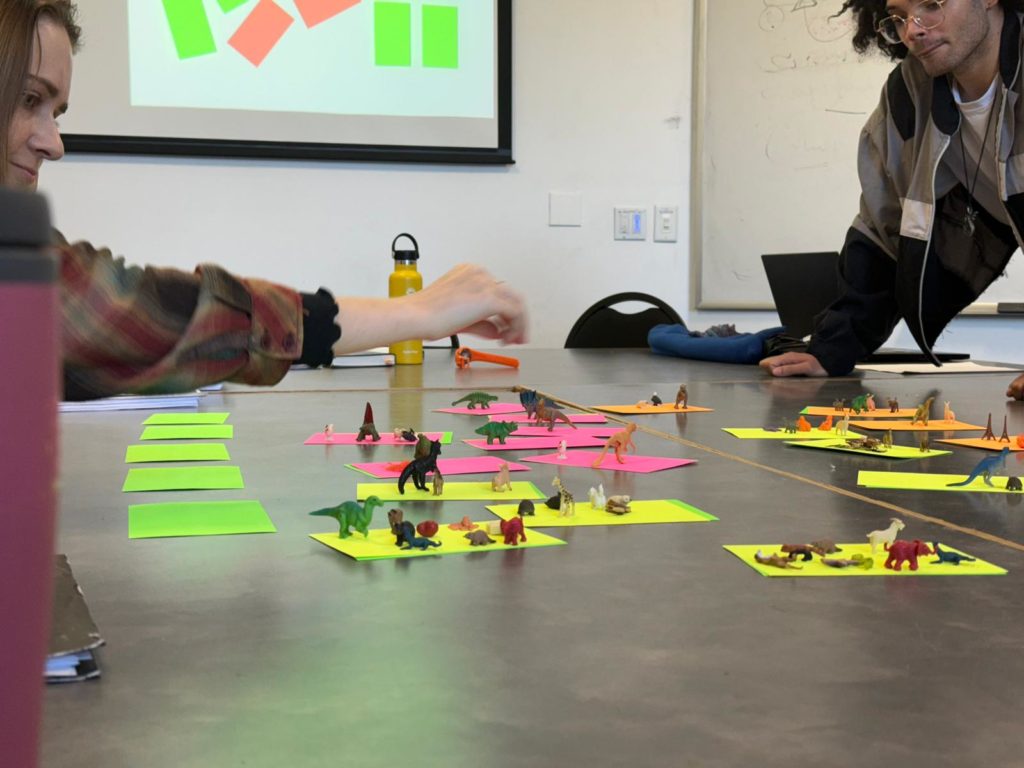
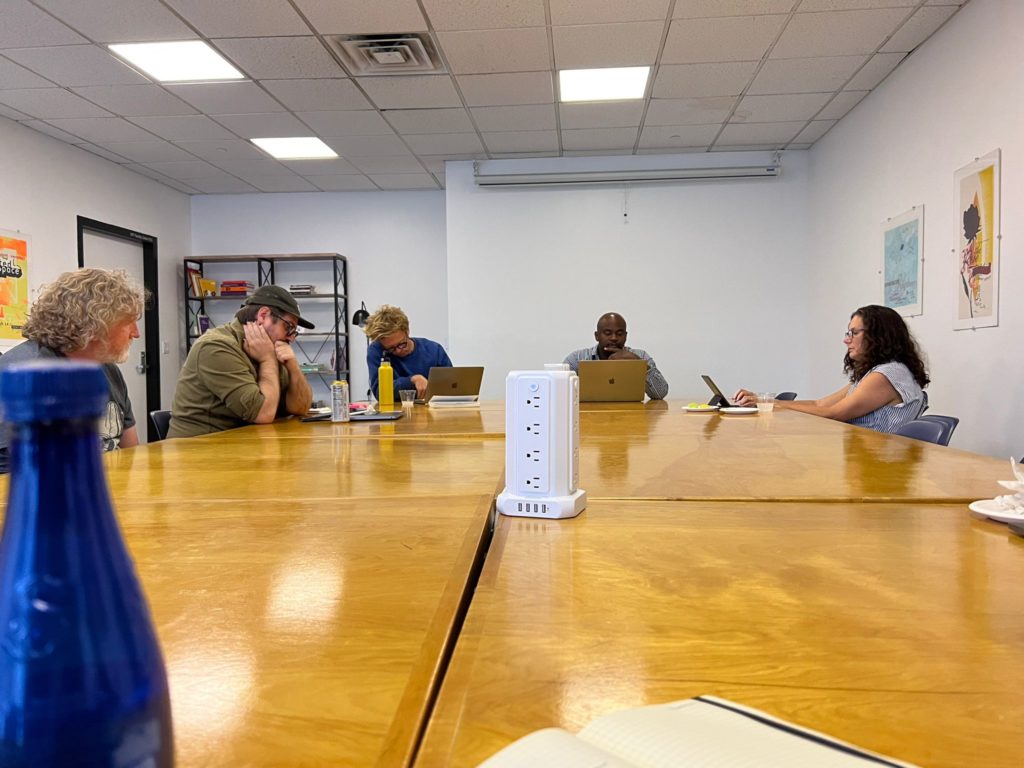

Solidarity in Fragments: An Experiment in Collective Critique
The 2026 Aesthetics & Politics MA2 cohort: Summer Rogers, Reina Akkoush Halabi, Sean Koa Seu, and Jacob Blumberg.
⌑
Authors’ note:
“We don’t want to say much in advance about what kind of event of reading or encounter the book can become. We tried not to provide even this preliminary.”1
Can you count on solidarity? Solidarity today feels constrained by an attention economy run by ragged, bite-sized affective surges within an infinite doomscroll. Solidarity is fragmented, and so our responses perform that too. To generate a collectivity, we have shuffled our multiple short reflections on the topic and anonymized them. But we are also clear-eyed that the removal of singular authorship does not protect us from our individual vulnerabilities and specific limitations, our different locations within and under structures of power.
This is an experiment in performative writing, one which does not simply say but also acts. In How to Say Things With Words, J.L. Austin writes of the locutionary, illocutionary and perlocutionary acts in language. The locutionary is the “act of saying something,” the literal act of speaking words as sounds meant to transmit meaning, while the illocutionary and perlocutionary suggest word being used to induce action.2 In terms of action, the illocutionary dimension of speech is the force or intention that drove the speaker to utter their words, the “performance of an act in saying something as opposed to performance of an act of saying something.”3 Whereas the perlocutionary effect of speech is the consequences the acts has on others: to persuade, to delight, or move them into action. In this work, we hope that our words are not merely read to be understood but experienced for their performative intensity, moving the audience from tacit listeners to active agents. Our intent is to produce a butterfly effect of perlocutionary action, an instigation through words.4
Perhaps what emerges from such a process is closer to poetry than criticism, but we will leave that distinction up to the reader.
*
For two years, I was on the move. First, countries, then states. Leaving Beirut for California was jarring, but expectedly so. I had steeled myself for isolation and culture shock. What truly frightened me was leaving Los Angeles for Iowa City. I’ve always been an urban creature, raised in the metropole’s chaos. In Beirut and its congested Dahye (southern suburbs), I roamed every alley, always finding more to discover. Los Angeles magnified that a thousandfold. Its sprawling roads, artistic pulse, and chaotic grit were impossible to fully know and beautiful for it.
I would visit Iowa City often during my first year of graduate school.5 The city was walkable, friendly, safer than anywhere I’d lived. It did not feel like a city. It reminded me of my southern Lebanese village where everyone knew everyone.
A year later, my partner and I married, and I moved to Iowa City for good. Grave isolation hit. My visa barred me from working; my partner, Nova, worked all day. I knew no one. So, I walked. For miles.
*
When it comes to the study of matter, solidity is defined by a material’s ability to hold its shape.
{I am a shape-shifter}
A material’s composite parts– its particles– form relationships which are stable enough to resist external forces such as gravity and heat.
{I am a composition of dots, lines and planes}
Solids form these relationships in several distinct ways, but each way involves the mutual interplay of positive and negative forces; what physicists call a bond.
*
“To lock in, to lock out, the same act” – Ursula K. Le Guin, The Dispossessed
*
Continuous particles bound to one another form a distinct solid. A solid is a relief against which other unbound particles dance. Salts are a type of solid in which atoms enter into a mutually imprisoning relationship.
{Society dictates normative behavior}
In a salt, one atom of stronger force steals an electron from another atom. The electron is completely sequestered, and fundamentally changes both atoms into ions.
{I change depending on society’s dictum}
These ions, now bound to one another by total theft, are imprisoned in a rigid, monotonous, yet brittle lattice. Some examples of salt: baking soda, chalk.
{The colonized world}
*

Photo credit: Benjamin Hanson, Getty Images
When I think about solidarity, the first thing that comes to mind is a trio of Waymo cars lit on fire in the middle of a downtown LA street. I think about how an anti-ICE protest is also an anti-surveillance, anti-tech, anti-capitalist protest. The undeniability of mass-mobilization, the multitude’s insistence that these forces are linked, and should be confronted as one enemy. I think about the relationship of destructive violence and solidarity, building movements through shared rage, linking up together in order to tear something or someone down. Is this a strategy? Or is this a state of nature?
*
A covalent solid is a type of solid in which atoms of varying forces share power. Instead of complete electron theft, atoms in a covalent relationship will share an electron.
“In the social production of their existence, men inevitably enter into definite relations, which are independent of their will, namely relations of production appropriate to a given stage in the development of their material forces of production.”6
This bond is exclusive; there is a limit to how many electrons an atom may share; and once a constellation of atoms is neutralized, the solid cannot receive any more particles.
“The totality of these relations of production constitutes the economic structure of society, the real foundation, on which arises a legal and political superstructure and to which correspond definite forms of social consciousness.”
Although this is mutual exchange of power, it results in a closed system without exterior obligation. The solid cannot grow, nor can it change its configuration. It is locked. Some examples of covalent solids: glass, diamond.
“The mode of production of material life conditions the general process of social, political and intellectual life. It is not the consciousness of men that determines their existence, but their social existence that determines their consciousness.”
*
The act of creating impermeability, whether from the inside out in service of keeping some outside, or from creating closures from the outside to keep some contained, is always the same act. Walls built, regardless of their status of protection or containment, always create separation. Yet without them, solidarity would be impossible. An identification of those who you have locked out and who you have locked in is part of what it means to have “solidarity.”
*
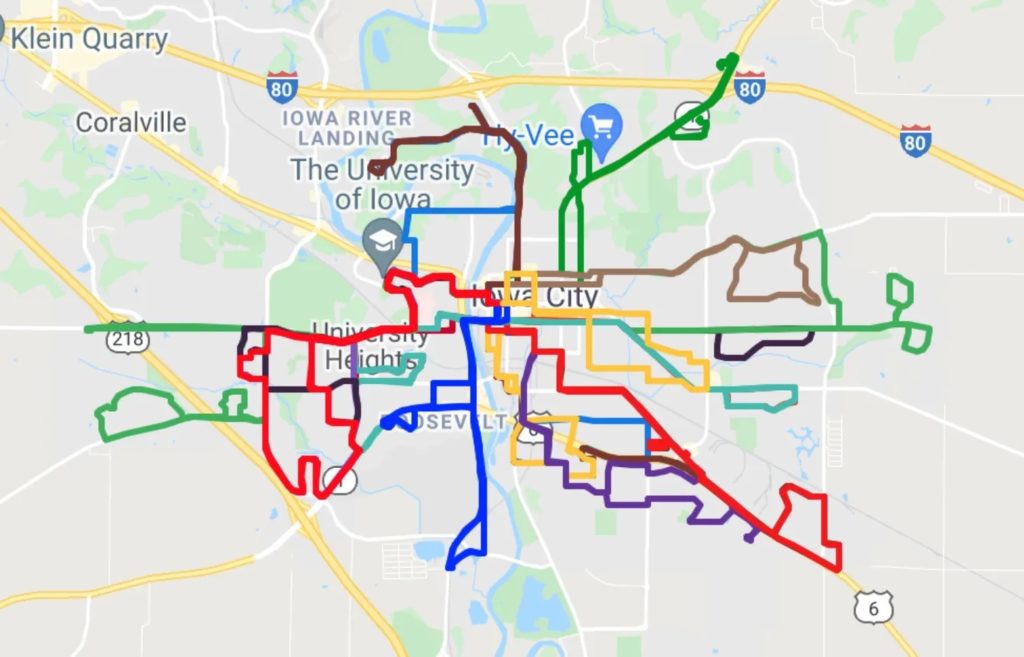
Graphic credit: George Shillcock, Iowa City Press-Citizen
Nova and I passed an older man sitting on a bench near Target downtown. Beside him, a backpack held a sign:
Give with your heart, and your kindness will be repaid.
His left foot was gauze-bound, padded medical shoe strapped on. Nova recognized him as Marty, a former patient. Diabetes blistered his leg, and he came into the hospital often to have his wounds cleaned. Marty was homeless. He was a local figure of Iowa City, fixed to his spot like a statue.
The next day, on one of my aimless walks, I ran into Marty again. We talked. He asked what I was up to. “Nothing, just walking.”
“I’ll show you around the city,” he said.
That summer, I spent most days walking with Marty as he narrated Iowa City’s history. His stories at times felt invented, but I did not make such claims to him. I enjoyed his engagement. Little by little, I learned bits of his past: homeless, banned from the local shelter, once incarcerated, and admitted to juvenile detention centers. I didn’t ask why. I feared an ugly reaction.
Eventually, he began to ride the bus with me.7 He knew my neighborhood.
*
Can I have solidarity with my barista? Can the minimum wage worker who is required to make my 11 am cappuccino with soymilk form solidarity with me in our cursory chat about the weather? What about when I tap my credit card on the terminal? Do they even remember me from last time? What about if we were in their kitchen, using the espresso machine that their mom gave them as a graduation gift when they completed their BFA? What would we talk about then, sitting at their dining table while they steam the milk?
*
A metallic solid is a type of solid in which power is shared among many atoms; each atom contributes an electron to a free-range, common field. There are no individual claims, and no rigid structure.
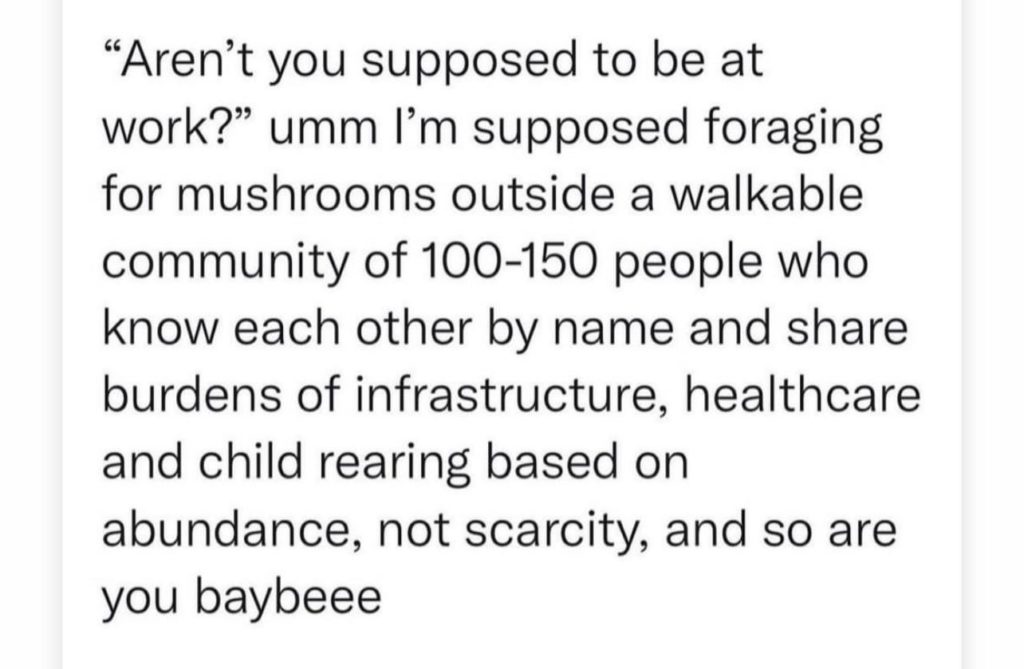
{My friend, Megan, a resolute lesbian anarchist with an affinity to catholic spirituality, visited this commune in Wisconsin. A three hour drive from Iowa. I found the home page text to be relevant: “Dreamtime Village is both an informal network of friends and contacts spread around the country and also a collective community of residents, buildings and land located in the Driftless Bioregion of southwest Wisconsin.” The Driftless Area is a region in Minnesota, Wisconsin, northwestern Illinois, and northeastern Iowa of the American Midwest that was never glaciated. It connects four states in the midwest.}
Metallic solids may be battered by exterior forces and yet maintain solidity, since individual particles can change their position while still staying linked to the common field. Metallic solids may readily accept outside metallic particles.
{Upon arrival, Megan was instantly handed shovels and rakes. She planted multiple trees in their garden. Short introductions occurred, but nothing too convoluted. The main purpose behind her visit was to offer help to a community she did not necessarily belong to, but was openly welcomed in}
Furthermore, these solids conduct power easily; the lack of constraints by individual particles enables the whole substrate to react. Examples of metallic solids include gold, copper wire.
{transnational labor movements}
*
Images of solidarity are a subset of political images, images that hope to catalyze broader social impact. Records of unity in the face of power, whether it be worker strikes, flotillas headed for Gaza, or anti-war demonstrations, outlive the moment of their making and in many cases come to stand for a whole movement or historical event. These images become shapers of political consciousness. Perhaps more mystically, images of solidarity are intended to perpetuate and proliferate sentiments of solidarity to viewers, through a kind of “political mimesis.”8
*
In solidum was a Latin term that described the mutual shouldering of debt. Debtors in solidum incurred debt as a single unit; each individual could be held responsible for the entirety of the debt, not just their individual share. This meant that debt was not divided proportionally, but rather, amongst all, as a unit. Despite the debtors entering into mutual obligation, an arrangement in solidum was designed to benefit the creditor; it maximized his chances of collecting, he could go after the wealthiest debtor, or the most accessible, or the weakest.
*
Documents of solidarity. Images as the receipts, indexical to a reality “that-has-been.”9 Do we still believe images convey such immediacy, such a power of the Real? Susan Sontag worried in 2003 that images of distant suffering would numb us rather than motivate action, and that was before deepfake technology existed.10 The ontology of the image as absolute Truth is always at war with its ontology as pure Spectacle, and today even more so.11 However, the question for political image-makers remains unchanged: are you willing to look at the world around you, and participate in it, regardless of the imperfect medium at your disposal?
*
Who are we mutually obligated to? In solidum obligated a group of debtors to their creditor; In solidum did not clearly delineate the obligations amongst the debtors. The equitable sharing of burden was sometimes mandated by the state, but was often hard to enforce. This legal concept proved durable; it remained, for example, in the French Civil Code’s concept of solidarité. But solidarité, like in solidum, was a descriptor not of the relationship between debtors, but of the wholeness of the debt.
*
How to document in solidarity? Not the creation of political images necessarily, but the political creation of images. The 2024 film Union by Brett Story and Stephen Maing achieves this through a performance of its own subjective positioning in the filming and editing of the unfolding story of Amazon fulfillment workers attempting to unionize. Such a performance is crafted through the inclusion of the filmmakers’ own actions in the final edit–their questions and interventions during filming–and through the way they refuse to ground the story in any one individual or pathos of heroic achievement.
*
“Class Solidarity” is a lateral identification of a group having solidarity within itself. It is therefore not a solidarity among classes, but members of the same class who identify their shared class identity. What would solidarity among classes look like? Imagine: Jeff Bezos allied with laundry workers in the struggle for higher wages in the hotel industry. He marches the picket line, chanting about better working conditions and better pay. He goes home and takes of his shoes, changes into pajamas, and lies on his bed. The maids have put fresh sheets on it. They smell faintly of bleach and Tide Spring Meadow laundry detergent, his favorite.

Photo credit: Lauren Sanchez, Instagram
*
When is the debt settled?
{It shall be a jubilee unto you; and ye shall return every man unto his possession, and ye shall return every man unto his family.12}
To whom does the debt belong?
{The land shall not be sold for ever: for the land is mine…}
To whom are we bonded?
{If thy brother… be waxen poor, and be sold unto thee; thou shalt not compel him to serve as a bondservant…}
*
Perhaps it is best to give up an attempt to classify or codify what is or is not an image of solidarity. Perhaps the aesthetics of solidarity will forever remain opaque when viewed from the outside. Insofar as solidarity is a state achieved by free and autonomous individuals, it resists homogenization and prediction.13 But we know such images do exist, have existed, and might still be created. It seems to me that an image of solidarity cannot be manufactured from an imagined “objective” position, just as it cannot be pure propaganda. Rather, it is a product of a particular relationship between image makers and subjects, one which has only recently been taken up formally in documentary studies.14
*
I stood, waiting at my bus stop. The driver parked, stepped out and asked to speak with me.
“Do you know the man you rode with?,” he asked.
“Yes, a friend who likes to walk,” I answered.
The driver took off his Oakley brand sunglasses, looked me in the eye: “He’s a sexual predator. He has hurt a lot of young women.”
My mind went blank, but I mustered an “Okay.” The driver told me to be careful. I said, “Don’t worry, I’d only been cordial. He never hurt me.”
What unsettled me more than the allegations (or perhaps, facts) made against Marty was the feeling of being surveilled simply for engaging a person on the street. Part of me appreciated the concern, another felt patronized. An act as simple as conversation put me under the town’s spotlight and left me naked to the public eye. I rarely walked around town with Marty since.
*
To set out intentionally, or critically, in a culture of idle observers invites surveillance. In “The Painter and Modern Life”, Charles Baudelair writes:
“For the perfect flaneur, for the passionate spectator, it is an immense joy to set up house in the heart of the multitude, amid the ebb and flow of movement, in the midst of the fugitive and the infinite. […] The spectator is a prince who everywhere rejoices in his incognito. […] (They) are an ‘I’ with an insatiable appetite for the ‘non-I.’”15
The flaneur ecstatically participates in the collective, giving themselves over to raw and unmediated experience. But solidarity requires a definite ‘I’ to amass a ‘we’ with political charge. Solidarity, we have found, is a bond.
In our fragmented writing, the incognito ‘I’ does not resolve into a single sovereign image, but generates structured pairings and juxtapositions of distinct elements. Ultimately this fragmentary authorship, alternating between poetics and boisterous assertions, nevertheless reaches out in a single illocutionary act for transformative social change. This is what Robin Zheng terms ‘solidarity from below,’ a move from a moralistic understanding of solidarity as obligation towards a way of conceptualizing collective power.16 Not as hegemonic force over others, but strong relational covalences with the potential for solidary action.
⌑
- Lauren Berlant and Kathleen Stewart, The Hundreds, Durham, Duke U. Press, 2019, p. x. ↩︎
- J.L. Austin, How To Say Things with Words, Lecture VIII, Oxford. Clarendon Press, 1962. p. 94. ↩︎
- Ibid., 99. ↩︎
- According to Austin, perlocutionary acts are ones which are produced through the consequential effects of locutionary acts. Those acts may include affective, active and somatic experiences in the audience instigated through words and language. For example, we can distinguish between “the locutionary act (they said that…) from the illocutionary act (they argued that…) and the perlocutionary act (they convinced me that…)”. The perlocutionary is a reaction, a consequence in the audience instigated by the author or speaker. ↩︎
- My partner, Nova, researched Huntington’s disease at the University of Iowa Hospitals and Clinics at the time, and currently works as a resident psychiatrist there.
↩︎ - Excerpts extracted from Karl Marx’s “Preface to A Contribution to the Critique of Political Economy”, 1859. ↩︎
- The buses in Iowa City are free.
↩︎ - Jane M. Gaines, “Political Mimesis” in Collecting Visible Evidence ed. Jane M. Gainens and Michael Renov. Minneapolis: University of Minnesota Press, 1999, pp. 84-102. ↩︎
- Roland Barthes, Camera Lucida. London: Vintage Classics, 1993. ↩︎
- Susan Sontag, Regarding the Pain of Others. New York: Farrar, Straus, and Giroux, 2017.
↩︎ - Jean Baudrillard describes our investment in the image-as-spectacle as “a brute fascination unencumbered by aesthetic, moral, social, or political judgements” (The Evil Demon of Images, in The Jean Baudrillard Reader, Edinburgh: Edinburgh University Press, 2008, pp. 83-98.)
↩︎ - See Leviticus 25:8-55, KJV. Verses on the Jubilee: a biblical law commanding the periodic relief of debt. ↩︎
- See Janet Sarbanes, Letters on the Autonomy Project, punctum books, 2022, p 58.
↩︎ - Two recent scholarly projects which combine close readings of films with theories of solidarity are Macarena Gómez-Barris, The Extractive Zone: Social Ecologies and Decolonial Perspectives. Durham: Duke University Press, 2017, and Palacios, José Miguel. Transnational Cinema Solidarity: Chilean Exile Film and Video After 1973. Berkeley: University of California Press, 2025.
↩︎ - Charles Baudelaire, The Painter of Modern Life, p.9
↩︎ - Robin Zheng, “Reconceptualizing solidarity as power from below” Philos Stud 180, 893–917 (2023).
↩︎