The بَنَدُورَة (Banadūra) Sandwich: Lebanon’s Impaired Futures, Lost Pasts and Void Present
The Assembly Linei.e. Mise En Place
The summer of 2025 was my first as an expatriate of Lebanon, a former insider watching events unfold from the outside, providing a distant affective lens. The three-month period embodied a microcosm of Lebanon’s contemporary condition, renowned for state-ordained complexity and externally imposed chaos. Lebanon has been wrought with a complex history since its inception. The civil wars (1975-1990) and Israeli occupation of Southern Lebanon (1982-2000) marked the beginning of a prolonged, protracted state of conflict, economic strife, and sporadic violence, both internal and external in origin. Much like a dormant volcano, these deep-seated issues follow a rhythmic pattern of calm simmering only to erupt in unpredictable bursts. The key to navigating the country’s perpetual political and economic uncertainties remains in the hands of the powerful few, who, in response, hastily muffle oppositional voices with superficial distractions. Thus, the emergence of the tomato sandwich was never unprecedented, nor unexpected, but rather another absurd specter of neurotic joy pushed forward during times of absolute uncertainty towards a future.
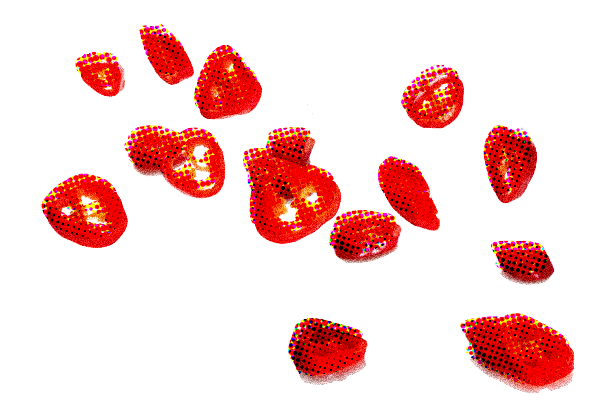
Em Sherif Deli’s Sandwich of the Month: July’s star item is made with banadoura jabaliyeh (Lebanese heirloom tomatoes), toum (garlic spread), sumac, extra virgin olive oil, green chili, and spring onion layered between two slices of sourdough. $13
The ad first appeared in the early weeks of July, only to become an issue of national debate mere hours later. The country was peripherally divided into three cantons: those who believed that the quality of Em Sherif’s deli, a conceptual store widely regarded as a high end authentic Lebanese restaurant, justifies a higher end price that only a select few could afford, others who vehemently opposed the cost of a meager tomato sandwich being double that of a beef shawarma at any local vendor, and those who simply did not care to involve themselves in the conversation. Nevertheless, the sandwich overtook Lebanese media by storm. The tomato would become, I argue, a diagnostic symptom of a hedonistic happiness, a eudaimonism, treading societal neurosis, which defines the Lebanese ‘post-colonial’ reality. The implicit and explicit hierarchies and systems of authority at play in Lebanon materialize on a micro-experiential scale with the tomato sandwich, which functions as a system of signs that question the possibility of the future in the post-colonial world.
The Filling:The Heirloom, the Contemporary and Identity
The Arabic banadūra (tomato), from Italian pomodoro, is a univerbation of pomo (“apple”) + d’ (“of) + oro (“gold”). The name denotes the yellow variant color of the fruit that was first brought to Italy and presented to the Medici Court. Despite red variants arriving in Italy later, the name remained commonplace and spread across the Mediterranean, giving rise to the alternate Banadoura. The tomato is a staple of the Lebanese kitchen, especially for its use in home-made stews, stuffings, and salads.
The Lebanese variety of heirloom tomatoes known as Banadoura Jabaliye (translated to Mountainous Tomato) is a seasonal offspring of decades of agricultural history in Mount Lebanon. They are large, round, and marked with cascading ribbed tops. Few are produced each season, which marks up their price compared to an average tomato. They are luxury produce.
To understand the significance of this tomato, one must first investigate the agricultural practices that distinguish heirloom varieties from hybrid varieties. In agriculture, an heirloom refers to a traditional, old-fashioned variety of a plant whose seeds have been passed on through generations, often within a community, family, or a specific region. Analogous to an antique or a piece of jewelry, the seeds are considered a familial treasure in organic form, capable of producing life and continuing a cycle of production and consumption. Like an archive, these heirloom seeds contain a heritage, a history, as they were selected, saved, and cultivated simply for their unique flavor, shape, color, and size. Heirloom varieties are valuable and have been sustained for decades through preservation, as their pollination is critically dependent on their identity. To put it simply, heirlooms are purebred foundation stock. They are always pollinated from another flower on a plant of the same variety, creating a virtually identical plant to its parents. In some sense, it is almost like cloning, save for some minor genetic differences. Characteristically, the produced plant is always identical to its ancestor, its parents. Heirlooms are pollinated naturally by wind, insects, birds, or other natural mechanisms, allowing farmers to save their seeds and continue the self-sufficient cycle of production without necessitating dependency on seed companies every season. It is a linked chain of sustenance, as if the tomato produces itself and its future variants through a process of preservation. Temporally and ontologically, the tomato is the past, present, and future of its being. It retains its origin while propagating its preservation. Thus, for it to be (être), it necessitates a good life, a well-being (bien-être).
In essence, the tomato is a truly sovereign object that can only be endangered in exceptional circumstances, such as natural disasters or parasitic invasions. In The Human Condition, Hannah Arendt reflects on the human capacity of creation, of starting something new and usually unexpected. She is widely regarded as the “theorist of beginnings”, dwelling on her concept of vita activa (active life) where she designates three fundamental human activities: labor, work, and action. She writes, “All three activities and their corresponding conditions are intimately connected with the most general condition of human existence: birth and death, natality and mortality. Labor assures not only individual survival, but the life of the species. Work and its product, the human artifact, bestow a measure of permanence and durability upon the futility of mortal life and the fleeting character of human time. Action, in so far as it engages in founding and preserving political bodies, creates the condition for remembrance, that is, for history.”1
Lebanon’s ties to action, as a condition to human existence, remain completely shackled to an object permanence towards temporality. The state functions in a persistent “empty present” that, unlike Arendt’s characterization, does not transition but remains stagnant. The colonial legacy of the Levant is one of disorientation and historical void. Modern Lebanese history remains undocumented, halted exactly at the moment of the dissolution of the French mandate in 1945, the foundational myth of Lebanese independence. This raises a pivotal question: why does the end of history begin at the nation’s founding? Scholars point to the civil war as a predominant concern. The state-sponsored policy of “no victor, no vanquished”, which actively discouraged a formal diagnostic process towards historicization, aimed to deter conflict from reemerging. But a proper foundation is not a simple one-time event, but rather, an ongoing active constitution of the public realm. In Arendt’s view, Lebanon persists within a foundational labyrinth, an era of complete fragmentation and alienation towards reality. In truth, Lebanon has no origin, it exists in a temporal dimension of static identity; of what Arendt would deem dark times. Theorist Ghalya Saadawi writes, “The dark, murky times are not the names and lists of twentieth-century tragedies, not the ‘genocides, purges, and hunger of a specific era. Instead, darkness refers to the way these horrors appear in public discourse and yet remain hidden.”
Much like the heirloom, Lebanon views itself as a static, unchanging object, cyclically regurgitating a narrative of purity, origin, history, and tradition sans the capacity to create something new, unexpected. The tomato in Lebanon represents a story of ethnic rootedness to the land, which is produced, packaged, and consumed as a commodity: a narcotic towards the fundamental uncertainty of a political realm that has failed to constitute itself. One consumes not a fruit, not a sandwich, but a palliative for a lost world, a lost future. Stuck in a state of heedless thoughtlessness, lacking the action which Arendt describes as the “the condition-—not only the conditio sine qua non, but the conditio per quam—of all political life”2, Lebanon recreates its nonexistence perpetually through active post-colonial amnesia. The mundane takes precedence over the political. “In the same way that one might ask ‘where is the artwork: in the showcasing, the encounter, the conceptual, the discourse or the critical writing?’ so too one would ask, ‘where is identity, origin, being?’. It’s not, not here.”3
The Garnish:Deception and Wealth
“[…] while some comfort foods play to memories of childhood and home, others play to excess and indulgence, providing a ritual and illicit escape from the crushing constraints of reality and adulthood.”4
The Lebanese liquidity crisis, exacerbated by the Covid-19 pandemic, Israeli aggressions, and the 2020 Beirut port explosion, continues to impact a large majority of the nation’s population. The fragility of the economy became apparent with liquidity shortages in the years before 2019, which remained deceptively concealed by the powerful elite. In the years following the pandemic, the Lebanese Lira had devalued by over 98% after being pegged to the U.S. dollar at 1,500 LL per dollar. Currently, 1 U.S. dollar is equivalent to 90,000 Lebanese Lira. This collapse fundamentally restructured public opinion on private banking, patriotism, and allegiance to the state. Public services collapsed, and the safety net of private businesses simultaneously shrank as prices for electricity, water, and other infrastructural essentials skyrocketed. Private bank deposits were withheld, as citizens desperately attempted to withdraw what little savings they had accumulated over the years.
In the West, scholars have noted the emergence of little treat culture, an explosion of luxury, yet affordable items that mimic an inversion of economic reality. Where most cannot adequately fund a significant investment such as housing, more minor indulgences in non-essential purchases offer a viable, mass-produced alternative in a world of inaccessibility. Advertisers lure consumers by marketing their goods as essential must-haves, echoing tall tales of spice traders spinning fables of the ‘exotic’ origins of their wares to justify exorbitant prices.
Pierre Bourdieu expands on the notion of symbolic capital by analyzing how economic wealth does not simply act as wealth, but also as a “variable form of recognition extended to wealth, depending on societies and moments”.5 In short, raw economic power exhibits a symbolic effect through recognition. An objectified form of capital, for example, may legitimize prestige, honor, and reputation simply through exchanges of material. The sandwich becomes an object of symbolic capital driven by the context of placement: aesthetic qualities of being seen in certain places that evoke wealth, such as a high-end deli in a gentrified area of Beirut. In fact, the simplicity of the tomato sandwich and the humility of its ingredients are an indicator of its social status. Its pristine, stripped-down aesthetic mimics that of quiet luxury. But behind it lay a chaotic reality and a messy political landscape that cannot be disentangled without inconvenience. What changes when the interlocutor is not merely a subject of wealth disparity, but also an enduring victim of a persistent post-colonial condition? Here, the certainty of death extends beyond the state’s regulatory power over its body politic. We exist in a realm of systemic war and large-scale extermination. Does the little treat offer any consolation?
The Bread:Smile! It’s Ready-To-Eat
History celebrates the battlefields whereon we meet our death, but scorns to speak of the ploughed fields whereby we thrive. It knows the names of the king’s bastards but cannot tell us the origin of wheat. This is the way of human folly. ~ Jean-Henri Fabre (1823 –1915)
The sandwich is an uncooked meal. It is a ready repast, easy to prepare, carry, and consume. It is simple and ubiquitous. In essence, the sandwich is deeply intertwined with capitalist consumption and profound hedonism. While ‘breaking bread’ may have begun as a group activity6, the current modular form of the sandwich is highly isolating. It is an ego-centric experience of hedonistic pleasure that is not meant to be shared. In turn, the subject who consumes said sandwich must intrinsically experience joy on an independent level, an example of self-discipline initiated by materiality. In her book, The Promise of Happiness, Sara Ahmed investigates the premise of happiness by asking questions on the moral and affective expectations instigated by the ‘happiness duty’. She writes, “Even if happiness is imagined as a feeling state, or a form of consciousness that evaluates a life situation we have achieved over time (Veenhoven 1984: 22–23), happiness also turns us toward objects. We turn toward objects at the very point of “making.” To be “made happy” by this or that is to recognize that happiness starts from somewhere other than the subject who may use the word to describe a situation.”7
Lebanon’s model of post-coloniality is complex and arguably atypical, presenting deep-seated issues since its imposed formation. It is plagued by a political system that entrenches sectarian divisions and narrows solidarity. Defined by instability, weak centralized governance, corruption, and ongoing conflict, the institutionalized confessional system set in place by the French mandate (1920-1945) imposes a temporal expansion of persistent conflict and political paralysis, creating a dynamic of complete dependency on the “caring mother”, France, and Western colonial powers, for political, cultural, and social stability. “While Lebanon was once referred to as Switzerland of the East, and Beirut as Paris of the East, the country’s past must not be seen as one of flourishing prosperity which went off-course. It was never on-course.”8 Yet despite persistent economic, political, and social stagnation, the Lebanese mindset is drawn to joviality and acts of emotional ‘resilience’. The affective is at the core of social normativity in Lebanese society.
To show distress is to show weakness. Performances of happiness are not only present but encouraged and even mandated, functioning as a flawed sense of resilience against internal and external corruption. It is simply a persistence of denial so severe that the subject internalizes said affect as accurate, vehemently oscillating between objects of joy and the severe reality of protracted colonialism in a manic state. The fabricated belief of joy becomes easy to digest, simple, and portable, much like a sandwich. Thus, the object of happiness is passed around, “accumulating positive affective value as a social good”.9 All the while, anxiety, fea,r and loss are shunned. “They are expressed as vulnerability in the pervasiveness of trauma, as a constant low-level distress, and through a generalization of contingency.”10 If we do not fear the future, is there room for possible change? The illusion of normative happiness is an opium, a barrier to revolution. Laughter is the sigh of the oppressed creature. The object of false happiness lures the oppressed towards a negative experience of the sensational by dislocating the subject of happiness from the conditions of its arrival.11 Thus, the purpose of the sandwich is multifactorial, as it perfectly sums up all these issues in a single micro-experience. A protracted state of neurosis coupled with passive ideological hegemony and protracted coloniality. The Lebanese subject is auto-inscribed with a disciplining sense of normative happiness, all the while persistently anticipating recognition (and later, prestige, honor, and even ‘humanity’) by the colonizer, the powerful, the few.
The Spread:Sensory Borders and Disturbances
In Miguel de Cervantes’ Don Quixote de la Mancha, Quixote advises his “peasant” squire Sancho Panza, on how to behave after becoming the governor of an island. “Eat not garlic nor onions, lest they find out thy boorish origins by the smell.” Don Quixote’s advice, while satirical, reveals the pretenses of social norms and customs in aristocratic society, many of which are rooted in masking. One is expected to keep hidden their less refined habits, such as eating, especially when involving cheap, pungent ingredients. Food aversions, especially to garlic, onions, and other produce in the Allium family, are interlinked with performances of cultural capital12.
Historically, there is a sense of abjection in the sensorial realm of odor. In Powers of Horror, Julia Kristeva writes, “Food loathing is perhaps the most elementary and most archaic form of abjection.”13 The abject, according to Kristeva, is what disturbs systems and order, a non-object which does not respect borders, positions, and rules. Nothing comes close to abject disturbance as much as odor, especially that of pungent food. It is an assertion of the I/Other, a disturbance that crosses the borderline of personal space in a public sphere.
The Kick:Defense Mechanisms, Pleasure and Pain
Perhaps one of the most interesting examples of the human capacity for pain tolerance is the global affair with chili peppers. Defense mechanisms developed by plants don’t phase us, in fact, we go so far as to relish their violence. “[…] whereas corn developed that tough outer casing to protect its seeds and other berries developed thorns, chilies developed a chemical defense mechanism in the form of capsaicin, the principal function of which is to cause predators pain.”14
This is a phenomenon known in industry as directed deterrence, aimed explicitly at mammals such as ourselves. Put simply, our teeth are seed destroyers. We do not propagate the fertilization of these plants, and therefore, nature prefers animals that do, such as birds, which are immune to capsaicin. What the plant does is target something beyond our taste buds. It is a sensorial and temperamental chemical reaction, the same one that “alerts the body to the presence of harmful chemicals and bacteria”.15 Thus, eating chili is not dissimilar to injury, a sensation of exposure to harm, a chemical weapon. Repeated exposure to capsaicin can desensitize receptors that signal pain in nerve cells, which explains why some people tolerate the literal and literary heat better than others. The question remains, however, why do we enjoy the pain inflicted on us by these plants? Perhaps it is a thrill, a form of benign masochism, or an attempt at regaining sensation where it had been lost.
The Drizzle: Choice, Exclusivity and Escapism
Human beings are biologically wired to crave choices, the new, the personalized. We desire, in evolutionary terms, variety. ‘The scarcity environment in which humanity evolved prioritized appetite: whoever got the most sex, or food, or stuff was likely to be a successful spreader of the seed’.16 To crave is to want, rather than need. The desire for the new, for the unexpected, cannot be satiated with passing trends. Jalal Toufic expresses a passion for creativity beyond a ‘surpassing disaster’, a disaster that has surpassed the temporal immediacy of a death toll and destruction to long-term, latent physiological and traumatic effects in the depths of the body. He claims, “In the aftermath of the surpassing disaster, tradition is in some cases totally withheld from the thinker and/or artist; in other cases, it is withheld from him or her as a thinker and/or artist, but not as a teacher or historian or a person. We do not go to the West to be indoctrinated by their culture, for the imperialism and hegemony of their culture is nowhere clearer than here in developing countries. Rather, we go to the West because it is there that we can be helped in our resistance by all that we do not receive in developing countries: their experimental films and video art, their ontological-hysteric theater, their free improvisation, etc.; and because we can there meet people who can perceive, read or listen, and genuinely use pre-surpassing-disaster art, literature, music and thought without having to resurrect them.”17 Perhaps, this is the main issue at hand: a formal diagnosis.
Lebanese society is defined by terminal temporality, an extended, deeply unmedicated surpassing of disaster. We bandage prolonged injuries in the hope of resurrection. Yet a wound that never heals devolves from pain to apathy. Apathy, in this case, does not denote absence, but rather a cynicism towards the value of building a future or historicizing a past. Stuck in a recurrent moment of perennial hyper-consumption, the individual anchors their sense of identity in benign symbols of tradition: a tomato, a dance, a song, a flag. Yet these small comforts merely fuel a fragile retreat from reality. Perhaps, once every bite is taken and no crumbs are left, once even the phantasm of happiness is destroyed, and joy is rendered obsolete by impending peril. We may face the pessimism of our precarity to destroy the world imposed on us by our oppressors and hurl it back in their faces.
Hannah Arendt, The Human Condition (Chicago: University of Chicago Press, 2018), Introduction ↩︎
A concept by French philosopher Pierre Bourdieu which refers to non-financial assets, such as social skills, etiquette, knowledge and education, that may promote social mobility. ↩︎
Julia Kristeva, Powers of Horror: An Essay on Abjection (New York: Columbia University Press, 1982), 2. ↩︎
@subwaytakes brings celebrities down to earth (literally), interviewing them in the United States’ largest public transit system.
The Zohran Mamdani mayoral campaign was heralded for its use of street aesthetics; so much so that his rival, Andrew Cuomo, attempted to copy Mamdani’s street-easy demeanor on social media.
Of the ten thousand talking heads droning at us from the ten thousand screens, no one is more recognizable than the man on the street. You know him from the local news, standing in front of a local grocery store, a courthouse, or a metro hub, dressed for the weather. He’s Joe Citizen, she’s Jane Doe— more or less eccentric but always keeping it real. Despite the ever-present microphone, we do not need to hear a man on the street to recognize him; he is always (obviously) on the street, and his microphone is always in someone else’s hands.
You can catch him in short-form videos on platforms like Instagram and TikTok, and he is experiencing something of a renaissance. On the streets of the metropole today, influencers wielding smartphones hunt unsuspecting strangers in search of an interview. People walking down High Street must stay on High Alert, lest someone hurl an inane question like “what are you listening to?” their way, hoping to catch a reaction. One can’t step foot inside a commercial district or a city park without being accosted.
“What are you listening to?” is one of the most common formats for street interviews. The form relies on spontaneity, documenting the random pedestrian’s listening habits.
Perhaps you yourself have been a man on the street. I remember being a child, playing in a fountain at the Seattle Center while a journalist asked my father his opinion on the War in Iraq. There was a whole team, someone manning a camera, another on a boom mic. I don’t remember my father’s answer, but I do remember us gathering around the TV as a family later that night. More recently, in West Hollywood, I was asked my contraceptive preference by a man wielding an iPhone (I declined to answer). That experience was different— I did not realize the man was recording me until after he asked me his question. There is a strange feeling I get in public nowadays that we are all, in some sense, always at risk of becoming the man on the street with the swipe of a thumb.
And this is the point, isn’t it? To capture a person in their “natural habitat,” to make one believe that a shared environment means— what exactly? — that they exist in the real world, a shared world? And that this real, shared world lends credence to the things we say and believe?
As quickly as this new social media form has proliferated, it has just as quickly become threatened, like many mediums, by Artificial Intelligence. AI can generate not only dialogue but also incredibly lifelike images of interviewers, interviewees, and the streets they walk. The real world is no longer legible— the “reality” that once lent interviews their validity is quickly disappearing from our screen-world altogether.
As realistic as AI has gotten, it still can’t pronounce “St. Tropez.”
Which leads us to the question: can we still trust the opinions and dispositions touted by the interview form? Could we ever, really?
The Dialogue
GORGIAS:What do you mean, Socrates? SOCRATES:I mean that he has not exactly answered the question which he was asked. GORGIAS:Then why not ask him yourself? SOCRATES: But I would much rather ask you, if you are disposed to answer: for I see, from the few words which Polus has uttered, that he has attended more to the art which is called rhetoric than to dialectic. Gorgias, Plato, Project Gutenberg
The earliest “interviews” come to us from the Socratic Dialogues. While it is impossible to know why Plato recorded his philosophy in dialogue form, we read in Gorgias about a distinction between “rhetoric” and “dialectic.” The dialogue between Socrates and the rhetorician Gorgias seeks to uncover the nature of rhetoric— Socrates grills Gorgias as well as any persistent interviewer. Of course, it is through this interview that the dialectic method is performed— the call and response, so to speak, of two interlocutors attempting to arrive at truth, and when Gorgias cannot provide a satisfactory answer to any of Socrates’ questions, Socrates gives his own examples of dialectic, preferring them to Gorgias’ flowery speech. Eventually, Socrates dismisses the ability of rhetoric and speech-giving to tell the truth. Rhetoric is only a method of persuading one to your opinion, which may be right or wrong. Truth— the real truth— only reveals itself through reason. And reason, apparently, is only possible if we are allowed to openly question a rhetorical claim and to hear our question acknowledged and answered. This is what we are led to believe via the dialogue’s Q&A-style questioning. Today, we refer to this dialectical questioning as the Socratic Method. It reveals a kind of dialectical truth that we are meant to believe is truer than mere rhetoric.
Also of note is this dialogue’s mise-en-scène; it begins at the exterior of the house of Callicles in Athens. Socrates must step inside the private home to pose his questions to Gorgias— he quite literally leaves the street to meet the rhetorician, a move notable, as Socrates was known to host his dialogues in public. But perhaps more importantly, the mention of the mise-en-scène within the dialogue gives it a sense of place, by which I mean a sense that a “third” person is observing. The exteriority of the scene implies objectivity; there is now an audience who can see the scene laid before them and judge the arguments accordingly. The questions (and their answers) seem “real,” as if they “really happened,” because we are meant to imagine them being said at a specific time and place. A reader of the dialogue can pretend to be a bystander, unaddressed. Unlike an essay or speech, which is addressed directly to us and can be adjusted to the rhetorician’s aims, the dialogue is set and factual because it does not involve us, thereby removing us from the aims of rhetorical motivation. The truth portrayed in the dialogue is uncorrupted because it does not involve an outside agent— us— as interference. This is a different kind of truth; I’ll call it documentary truth. It is similar to the sort of truth that underlies our modern notion of history. It claims a specific when and where that lends almost archival validity to the dialogue’s content.
But of course, this is an illusion. We are addressed by Plato, and the dialogue is a work of fiction. And perhaps by Socrates’ definition, the dialogue is an advanced type of rhetoric, even more deceitful since it pretends to have this type of objectivity when it, in fact, does not. The real dialogue is not between Socrates and Gorgias (did they really exist?) but between us and Plato— we should therefore ask ourselves what Plato’s aim is in divulging this fiction to us.
All this to say, there is an inherent (but illusory) trust in the dialogue as form. Not only are we led to believe that 1) dialectic itself is a more valid way of truth-seeking than pure rhetoric, but 2) the document of this dialectic professes something of the real, even if it is only mimesis, by claiming to be a transcription of words actually spoken. The irony between the two lies in the fact that dialectical truth claims a sort of truth-as-concept, where the documentary truth is a truth-as-event. These two truths do not necessarily validate one another. After all, someone may lie, or hold an incorrect opinion, and a document recording that lie would constitute documentary truth: yes, that person did lie here.
Definitions
Of course, none of the Socratic Dialogues are interviews, not really. We know that interviews are meant to be factual— the Socratic Dialogues make no such claim. We also expect the interview to be a bit one-sided; interviews are never a true dialogue. In her list of tentative definitions of interviews, Communications scholar Paata Natsvlishvili distinguishes between the two interlocutors of an interview: “one party— the respondent or the interviewee, is the possessor and source of some definite information; the other— the journalist or the interviewer— is the receiver and disseminator of this information.” This makes the interview different than a true dialogue, in which people of equal footing exchange words. In the interview, there is clearly a mediator (the interviewer) who facilitates the exchange of information from the interviewee to the audience. The mediator must stick to this role— as Natsvishvili emphasizes, interviews “exclude discussion.” This disbars a host of other forms, including the contemporary podcast, the presidential debate, and the two-hander play.
“The interview,” she goes on, “unlike all other journalistic genres, serves to show the opinion of the respondents but not of the journalists themselves.” Of course, what is notable in this definition is the admission that most journalism is couched in the subjectivity of the journalist— that, by filtering information through a reporter, we understand it to be somehow corrupted or manipulated by the press. The interview, then, bypasses this editorializing.
The Barbara Walters interview of Monica Lewinsky had 70 million viewers, according to the New York Times, making it one of the most-watched television interviews of all time.
The Interview
As ubiquitous as the street interview is today, the interview form in general is relatively new— at least in the field of journalism. News historian Michael Schudson traces the journalistic interview to 1836 (or perhaps even later, in 1859) and labels it a particularly American phenomenon “especially suited to a democratic society.” In the latter half of the 19th century, journalists in the United States began to cultivate what then seemed a uniquely privileged position— they were not only able to question power directly, but also to expect an answer. According to Schudson, the interview became firmly entrenched in American journalistic practice when President Andrew Johnson “submitted” to an interview in 1868. It may be that the press enjoyed a unique amount of leverage in the American political system, a kind of leverage made possible by print’s influence on the electoral system.
Before this, the direct questioning of power was not done in public— journalists may have questioned power behind closed doors, but that power (presidential, royal, papal, administrative, artistic) was never quoted directly. Journalists were even discouraged from taking notes. This is because the press, as an estate, had traditionally served as a mouthpiece to power, not a fact-checker of it. Editors heavily influenced the stories of their writers, and a story that did not quote, but rather relayed, was much more pliable under an editor’s gaze.
So the interview upset this power relationship in two ways: by quoting power directly, it did not (supposedly) allow for editorial adjustment (after all, those were the president’s exact words), thereby shifting power away from editorial teams to reporters themselves. Additionally, it changed the relationship between those in power and the readers of the newspaper— suddenly, the layman (if he was literate) could hear for himself what his Senator had to say, and could change (if he enjoyed suffrage) his vote accordingly. This was not so in the monarchies of Europe, which abhorred the interview as a particularly American blight.
The scandal of the interview process was as scandalous as the idea of democracy itself. Schudson remarks that the interview heralded a new sort of relationship of the press to the world, one of “impersonal surveillance.”(Schudson, 84) It created a world in which the powerful were always watched for the sake of being watched— or, in other words, the new press existed to convey neutral, impersonal information to the public. Public figures became truly public through publishing and publicity, and this was seen as a service to liberal democracy, which thrived (in theory) with a mature and educated people.
Vox Populi, Vox Dei
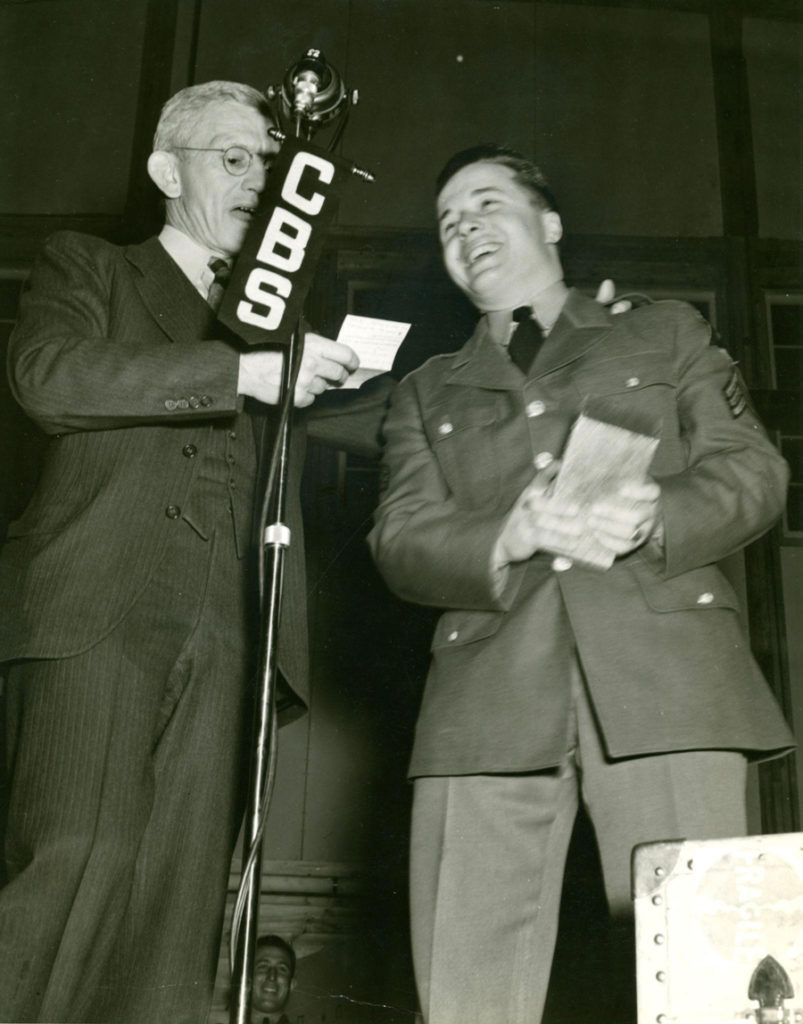
Sgt. John L. Berlew holds a gold brick during his interview with Parks Johnson. Fort Knox, Kentucky, March 23, 1942. From the Parks Johnson Collection at the University of Maryland.
Until the advent of radio and television, interviews were still a print phenomenon, which meant that they could always be edited (even if they posed otherwise). The shift of news to the airwaves would eventually change this. Vox Pop, a radio program broadcast from Houston and later New York City from 1932 until 1948, introduced a radically different interview format. Hosted by Parks Johnson and a rotating cast of co-hosts, the program featured interviews with Americans on the street, in hotel lobbies, in wartime factories, at festivals— anywhere the “typical American” could be found.
This was a notable shift in two ways: first, it used spontaneous, unscripted interviews, which had previously been rare on radio programs. While the program still maintained editorial power in its interview selection (just as newspapers retained some editorial power in print), the interviews themselves could not be greatly altered. They were “authentic” (straight from the horse’s mouth!), more authentic than a print interview could ever hope to be. This authenticity was, of course, always mere appearance. Who was selected for interviews and which interviews aired was always muddied by editorial interference.
Second, it shifted the interview format’s focus away from the senator and the candidate to the milkman and the riveter. The layman, who had considerably less to lose than his senator, could speak freely about the events of the day without fear of political or monetary retribution. This, too, bolstered the program’s authenticity, which cannot be overstated. The show’s title, Vox Pop, is an abbreviation of the Latin Vox Populi, Vox Dei: the voice of the people is the voice of God. The man on the street— spontaneous, unscripted, uncorrupted— had become a source of a kind of truth, by nature of his class. It did not matter that he had hardly time to think of his answers, nor that he lacked expertise; the dialectic of the interview, and the snapshot of him at a particular time and a particular place, was enough to endow him with (an admittedly tongue-in-cheek) holy authority. This authority was so recognized that the “VoxPop” became the industry term for man-on-the-street interviews throughout radio and television newsrooms. The term is still used in the industry today.
Some Vox Pop episodes from 1940. As with today’s street interviews, advertising is a prominent feature.
But Vox Populi was, in a way, a source of a kind of truth, insofar as it documented the opinions of people at a certain place at a certain time. Whether or not the opinions were correct or well-analyzed is beside the point. Because of the limited form of the interviews themselves (their brevity, their mediation through an interviewer, the types of questions asked), we cannot ever really claim to know if the man on the street even believed what he was recorded as saying. All we can really know is that a person said this thing at this time, which is a kind of truth, the documentary kind of truth. But here is the essential point— we should not confuse the documentary effect of radio (and later television) with the dialectical Truth with a capital T. An opinion at a given point in time may always be changed by persuasion, as Socrates has already warned us. It may be true that a riveter once said, “If you want to be an effeminate woman, you should have long hair, but if you want to be a modern woman, you should have short hair.” But is what she said true?
Billy on the Street
Billy Eichner verbally accosts New Yorkers in public.
“Name a woman!” screams Billy Eichner into his microphone, accosting a woman with a yoga mat. The woman, clearly distressed, replies, “Name a woman?”
Billy on The Street, a television game show which aired intermittently between 2011 and 2016, is a street-interview show gone wild; often running (and screaming) through the streets of Manhattan, Eichner accosts passers-by with inane questions like “Does ‘from sea to shining’ sea include Tara Reed?” or “Are you jealous of Beyoncé’s success?” Startled, most people can’t answer basic questions. One man, when asked to name a movie, replies, “Radio Shack.” Another, when asked to name a white person, replies “Michael Jackson.”
Billy on the Street turns the street interview format on its head. The dialogue is often aggressive, and the questions are extremely niche or without context. The effect is an absurd exercise in the media’s confrontation with the public, wherein the seams between the reality of the street and the pastiche of the camera are on full display. Often, we see people waiting for the bus or a walk sign, suddenly pulled out of their day-to-day and thrust into frame. This leaves no time to adapt to being recorded, no time to gather thoughts, and hardly any time to curate a sense of sociality.
The authenticity here lies not in the opinions or statements of the interviewees, but rather in their raw bodily reactions to being accosted by a television camera. The verbal responses of these (wo)men-on-the-street are secondary to their physical responses, bewildered faces, their shrieks, or their sudden flights from the sidewalk. Rhetoric is gone; the truth lies only in the documentation, and we therefore cannot confuse the content of their words with the truth of the recorded image.
Hollywood tourists are asked misleading questions for “Jimmy Kimmel Live!” When asked who she’d like to see sign the newly minted Declaration of Independence, one woman answers, “Beyonce.”
In this way, Billy on the Street is the most honest of comedy street interviews. Across the continent, in Hollywood, Jimmy Kimmel Live! employs a rather different technique. In these interviews, people are not accosted— instead, they are asked a series of misleading questions, such as “We’re talking to people about some of the current events that are going on right now. Would you like to congratulate Amelia Earhart on becoming the first female pilot to go transatlantic?” The interviewees then answer the questions as if the information presented to them is a fact when, of course, it isn’t.
These questions, designed to elicit an uninformed reaction, certainly undermine the notion of Vox Populi, Vox Dei, but is it valid? After all, the questions are designed to entrap, taking advantage of a person’s trust in the media in order to humiliate them. On the other hand, many of these questions seem basic, obviously false; the comedy lies in the street-person’s inability to discern basic fact from fiction.
Jordan Klepper interviews members of the MAGAverse.
Jordan Klepper’s segment on The Daily Show makes similar use of the man-on-the-street interview, but without the entrapment. In his interviews of MAGA supporters in the “MAGAverse,” he records his interviewees touting conspiracy theories without much effort to correct them. “Biden is a pedophile,” spouts one woman at a rally for Trump’s inauguration. “He likes to sniff kids.” These interviews employ not entrapment but rather the use of statements so absurd that they must be untrue.
What these comedians reveal about the man on the street is that he is not to be trusted. No longer are we listening to interviews in good faith— nor should any of us street people trust an interviewer to be looking for the truth. The street, it turns out, is a chaotic place with uninformed people; it can no longer hold any sort of dialectical truth. What remains, still, is the truth-of-place, the sense that we are neutral observers to a conversation, that strange truth of the documentary that tells us— what? That someone said an absurd something at a here-and-now which could change at the next there-and-later.
Death of the Interview?
Are You Okay?” uses the interview form to sell BANG energy drinks.
But we no longer need to rely on journalists, radio show hosts, or even comedians to conduct a street interview. The advent of the iPhone, along with the proliferation of monetized short-form videos, allows almost anyone to begin conducting their own interviews. I might take my phone and head out to the Americana, or the Strip, and start asking people about their favorite movies— or something more personal, like their contraceptive choice. And I can do this with almost no training whatsoever, and no editor to question my motives, except perhaps the unreliable content filters and algorithms of the platforms on which I post.
This is the logical conclusion of what was once touted as journalism’s most democratic form. We have managed to remove, even, the journalist (or perhaps we are all journalists?) Does this offer revolutionary potential, in which regular, even marginalized people can engage in a dialectic with one another? The thought is a hopeful one, but the reality is that the people making these videos often have no greater mission than to drive views, likes, and revenue. The price we pay for this capitalist democracy is that we are now all surveilled, monitored for our views, and then sold to tech companies. The democratic potential of the iPhone street interview seems not very democratic at all. It is often sold for blatant self-promotion, data farming, and advertising; its purpose is to generate capital. It does not pretend to do anything more noble than that.
Still, we wonder: what is so entertaining about these street interviews? From a purely aesthetic standpoint, the street interview is unique and recognizable in its form. We instantly know we are watching a street interview, even with the audio off— the microphone in front of someone’s face, the movement of the phone camera, their place between brownstones or at the park. The form is recognizable enough to interrupt an otherwise erratic scroll through short-form videos. We may even recognize where the street interview is taking place or at least make an attempt to locate it. Oh, look, it’s the Tesla Diner! Oh, she’s in front of my CVS! I ride MUNA! I take the Metro-North! It is this visual hook that keeps us invested in the interview, and the feeling that the person being interviewed is in the world, is not separate from us. The parasocial relationship between a person in a street interview is different from our typical relationship with a celebrity and their influence. We might run into this person in the checkout line. It does not matter if we ever do, if they are who they say they are, or if they even exist—the visual urban hook is enough. And, in the world of short-form video scrolls, even a second of attention is enough to generate value for the video creator.
Fake Streets
@joeyonthestreets creates entirely AI-generated street interviews. Who is Joey? Is he based on a real person? Does it matter?
This is nowhere more exemplified than in the newest form: the AI interview, wherein generated interviewers interview fake people on fabricated streets. In these interviews, the form is completely hollowed out. We recognize it as an interview—all the cues are there—but it no longer serves any truthful function; not even that of the most basic truth —the document —which at least admits that someone was somewhere at some time. No, neither the dialectical nor the documentary truth exists in these AI interviews; the irony between the dialectical truth and the documentary truth has been resolved by pure negation. There is no longer a dialectical truth (the dialogue is meant to sell likes, not generate dialogue) nor a documentary truth (the then-and-there is fake, too). The only “truth” we can salvage from these types of AI videos is purely aesthetic— we saw the video; it exists. This is a kind of solipsistic truth, where the only thing we can know to be true is our unmediated experience. Still, the form persists, a pure reaction to the vestige of our attention-giving habits.
What, then, must we do about our dearly departed form? Should we, like Plato, disavow the truth in any kind of art and rhetoric, clean our hands of the whole enterprise, say to hell with it! Are we to throw away the interview in particular, or perhaps journalism in general, in favor of what we can know by our own eyes and ears? We might be hypocrites to dismiss all artificiality. After all, Socrates never recorded his own dialogues; Plato, perhaps the most masterful of all Rhetoricians Against Rhetoric, recorded them– and likely made them up. In a way, the artificiality of the Platonic dialogue– as far as the mise-en-scène is concerned– is no different than videos created by artificial intelligence. Imagine, if you will, an AI video of the dialogue between Socrates and Gorgias. Keep the dialogue exactly the same (you can use a translation or the Greek); the argument remains coherent, even if the scene is out of context. If there is a Truth, like Socrates claims there is, it may be preserved in the dialectic, even if the documentary truth is completely absent. In fact, this is true of the original text of the dialogue; we can never know whether it recorded a real time or place; we can only follow its dialectical argument. All of the Socratic dialogues are ancient simulations, aren’t they?
A street interview I created with Sora2. The dialogue is lifted from Benjamin Jowett’s translation of Gorgias.
So we are not resigned to solipsism, not completely; that would be as absurd as losing trust in all text just because we found out that Shakespeare may have been multiple authors. Humans have long wielded simulation and artificiality to communicate. True, we may no longer know who said something or where they said it, but we can still glean information from what is being said. As AI-generated content becomes indiscernible from the real, we will have to relearn how to use the internet as a space for fiction. In fiction, there is no appeal to authority, no citing of trusted sources, no precedent for empirical evidence; there is just simulation, from which there is still much to learn. We must learn to read the internet as if it were a novel, a place of pure hypothetical.
Still, the empirical documentary truth is useful; and for that, we may have to take a page out of Socrates’ (or is it Plato’s?) book; instead of relying on the simulation for our news, we must rely on our own senses– to live as he did, in a real, unscripted, dialogic and documentary truth, would mean getting off the screen and into public, speaking with our neighbors who we can verify with our ears and voices and bodies, and understanding that truth, if it is anywhere, was never just in the airwaves or the print page or the telephone screen, but also somewhere on the street.
Rethinking Oil in an Ecofeminist Framework
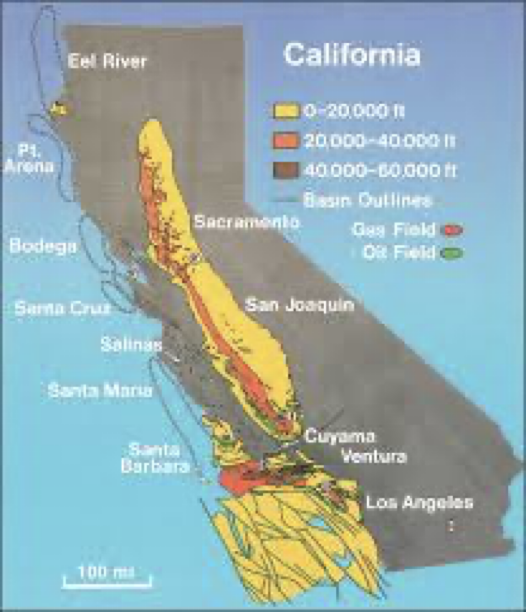
Milk and Oil in California Greta Gaard’s lecture at REDCAT presented a fascinating opportunity to consider interspecies justice as fundamental to ecofeminist critique and thought. Gaard began with a dream she had as a child. In the dream, an oil pump was drilled directly through a dairy cow in an open field, creating a violent mixture of blood, oil, and milk. From this psychoanalytic premise, Gaard skillfully tied the convergence of an economy of life, represented by milk, with an economy of death, represented by oil, under the broader context of bloody economic violence within capitalism. Like the dream itself, the logic of capitalism is not rational. Rather, it appears as a nightmarish flattening of life and death. Oil, created from the fossils of long-dead animals, can be exchanged equally with the milk produced by living animals (specifically mothers). To drive this point home, Gaard presented maps showing the locations of major oil drilling operations and industrial dairies in California. The maps are almost identical.
It would perhaps be wrong to call these maps “evidence” in support of Gaard’s childhood dream. Evidence suggests that the dream is an empirically verifiable premise that can be proved or disproved. Rather, the maps illustrate the relationship between capitalism and dreams, or more specifically, between capitalism and the monstrous, dreamlike realities it conjures into the real world. As Gaard goes on to explain, the overlapping locations of California’s major oil drilling sites and its major industrial dairies also correlate with high concentrations of poverty, disinvestment, and immigrant communities. If capitalism’s dreamlike ability to make the unreal real strikes one as magical or even liberatory, this third map reminds us of capitalism’s necessarily destructive implications. The surreal mixing of oil and milk in California’s central valley comes at the cost of high levels of air pollution and labor exploitation.
Gaard’s ability to weave together a feminist, materialist, and psychoanalytic critique was fascinating. The lecture opened up the opportunity to identify the surreal, subconscious currents that run through the networks of capital crisscrossing the largest state economy in the United States. As Gaard noted, this is particularly resonant in Los Angeles, a city whose economy depends mainly on selling fantasy and illusion. The lecture further allows us to consider how practices borne out of love and care, such as infants suckling at their mothers’ breasts, can be coopted and fed into the cold economic logic of capital. The implications of this are profound. As Gaard noted while describing the structure of modern industrial dairies, no one asks what the cows want. Armed with this outlook, we can approach the world as a site of exchange between human and nonhuman actors, between dreams and reality.
With that said, Gaard’s lecture did not seem to fully account for the implications of its own argument at times. Gaard spoke of the extraction of milk from cows in industrial dairies as a diversion of sorts. While milk primarily circulates between mothers and children, or as Gaard importantly clarified, capitalism diverts this flow between mothers and other mothers. In a capitalist system, milk becomes a resource to be extracted from cows and turned to profit—all the while, the dairy cows are worked until they collapse, and their calves are separated from their mothers to be raised until they can themselves be milked or slaughtered. Thus, once milk has been diverted into a system of capitalist exchange, the violence of its production becomes apparent.
However, oil has no comparable diversion. In Gaard’s framework, oil exists either as a capitalist commodity or doesn’t exist at all. The effect of this is to undercut the very point of the comparison between oil and milk. As a conceptual intervention, ecofeminism seeks to restore the vitality, agency, and subjecthood to those individuals and materials that capitalism has reduced to commodity status. Ecofeminism seeks to situate “humans in ecological terms and non-humans in ethical terms.”1 By suggesting that oil has nothing more to say, Gaard inadvertently limits the applicability of ecofeminism as a method. Gaard’s lecture illustrated the possibilities opened by this framing, which made her refusal to consider the potentialities of oil particularly disappointing. By this, I do not mean to suggest that oil be given a positive or liberatory valence. Rather, I simply suggest that the possibilities for considering oil’s psychoanalytic or metaphorical dimensions are likely more expansive than merely stating that it should remain buried below the earth’s surface. In fact, this response itself raises a psychoanalytic flag. Suggesting that oil remain subterranean and not be permitted to rise to the conscious surface carries more than a hint of a repressive tendency.
Rethinking Oil’s Conceptual Possibilities The logical question that follows then is, how can we better think of oil’s conceptual possibilities? Gaard begins her discussion of oil with a description of the La Brea Tar Pits, a prehistoric pool of oozing oil and tar bubbling up in the center of Los Angeles’s Miracle Mile district. The Tar Pits are also home to an archaeological museum and have thus become a popular attraction for visitors to Los Angeles. Perhaps most important for the tourist appeal, though, are the life-size models of two wooly mammoths, an adult and an infant, watching in helpless horror as a third mammoth model futilely struggles to escape from the tar. Gaard suggests that the entertainment value of this scene derives from taking comfort in not being stuck in the tar oneself. For Gaard, this perspective depends on Western divisions between subject and object, and the inability or refusal of the former to extend empathy to the latter. This framing focuses primarily on the panic visible on the faces of the mammoths while sidelining the function of the oil itself. This misses a fundamental aspect of the display.
When the lighter elements of oil evaporate, thick tar is left behind, which acts as a fossilizing agent for the unfortunate animals trapped in it. This is an important part of the scene recreated at the La Brea Tar Pits. By depicting this initial moment of fossilization, the viewer is forced to reconcile not with the distance between now and prehistory but rather with its temporal proximity. The display’s sinister allure can be attributed to the horror the viewer experiences upon realizing that the tar pit, which fossilized prehistoric animals, persists to the present day. Oil collapses time, simultaneously showing us what remains from millennia past and what awaits us.
Finally, we can reinsert this understanding of oil into Gaard’s initial framework. If milk is pressed into capitalist exchange at the cost of depriving the infant animals for whom it is produced, oil can be understood along a similar line. Oil is a product of death and fossilization that occurs over a geologic timeframe almost too large to comprehend. When it bubbles up to the surface, it becomes a noxious symbol of deep time, forcefully connecting the contemporary observer to prehistory. Of course, like milk, oil can also be redeployed as the lubricant of capitalism itself.2 To the extent that capitalism presents itself as a historically transcendent phenomenon, the connections to the past that oil represents are erased in service of capitalism’s claim to an eternal present.
The effect of this reconceptualization would be to strengthen, not detract from, Gaard’s thesis. Ecofeminism’s theoretical power is in rectifying Enlightenment thought’s division of “man” from “nature.” It prioritizes the contingent, horizontal, and interstitial over the hierarchical, segmented, and rigidly rational. Ecofeminism values what has been discarded and devalued by Western thought. It would thus be contrary to ecofeminism’s primary tenets to dismiss oil as an irredeemable material. Just as milk connects mother and child, or animal and human, oil connects the present to the past. If milk creates horizontal connections, oil creates vertical ones. It is unavoidable that a substance which connects the present to the past via the process of fossilization would be imbued with an aura of death. It would be lazy to suggest that this deathly quality is synonymous with capitalism. Capitalism may posture itself as universal, but death truly is.
A still from the final scene of Miracle Mile (1988).
Diamonds in the Tar Pits Gaard’s discussion of the La Brea Tar Pits reminded me of Miracle Mile, a 1988 movie filmed almost entirely on that stretch of Los Angeles that gives the film its name. Early on, the protagonist, Harry, accidentally learns that a nuclear weapon is heading towards Los Angeles, and he spends the remainder of the film attempting to find the woman, Julie, with whom he had planned to go on a first date that day. Though the couple eventually reconnects, they are unable to escape Los Angeles. At the film’s climax, the couple, trapped in a downed helicopter, attempt to console each other as they sink into the La Brea Tar Pits. Harry comforts Julie by suggesting that once they’ve been encased in tar, a direct hit will metamorphosize them, turning the lovers into diamonds. A direct nuclear strike puts them out of their misery and perhaps begins the metamorphosis of which Harry spoke. I bring this film up because it exemplifies how oil can be alternatively conceptualized. The function of the oil in Miracle Mile is to trap the young lovers, but it also transforms them into living fossils, a precondition for them to become diamonds. It is notable that the only solace Harry can provide as they await certain death is that together they will become earth itself. Whether as fossils or eventually, as diamonds, Harry and Julie are able to transcend the tragedy of their circumstances. Perhaps they will come to haunt future visitors to the pits, as so many visitors to the La Brea Tar Pits are. It is a disconcerting ending, but it is also one that simultaneously erases any distinction between “human” and “land” while also allowing the couple to survive, in some form, that most destructive fulfillment of masculinist Western scientific rationalism, the nuclear bomb.3 Perhaps this is an application of oil that ecofeminism can support.
Plumwood, Val. “Gender, Eco-Feminism and the Environment.” Chapter. In Controversies in Environmental Sociology, edited by Robert White, 43–60. Cambridge: Cambridge University Press, 2004. ↩︎
See Adam Hanieh, Crude Capitalism: Oil, Corporate Power, and the Making of the World Market (London: Verso Books, 2024). ↩︎
See Cohn, Carol. “Sex and Death in the Rational World of Defense Intellectuals.” Signs 12, no. 4 (1987): 687–718. http://www.jstor.org/stable/3174209. ↩︎
Description and Philosophy: Filling Ecofeminist Gaps
On April 16, 2025, ecofeminist scholar and activist Greta Gaard visited the California Institute of the Arts as part of the lecture series Ecofeminisms: Practices of Survivance. At the REDCAT Theater in Los Angeles, Gaard gave a talk titled Milking Mother Nature II: Ecofeminism, Milk and Oil, in which she developed an argument about the similarities and interrelationships between the exploitation produced by the oil and dairy industries. Focusing on the case of California, the presentation offered a clear description of the social and environmental criticality of these two activities, explaining in detail the scale of both phenomena and their consequences. In addition, Greta Gaard developed a theoretical framework in which the intersection of these two industries appears in three fundamental aspects. On the one hand, the land where oil is extracted is geographically contiguous to the land where cattle mega-farms are located. On the other hand, most of these facilities are located in racially and economically disadvantaged areas, affecting the quality of life of marginalized groups. Finally, metaphorically, oil extraction and intensive dairy production belong to the same imaginative sphere, linked to the idea of “milking” nature beyond a threshold of sustainability.
In the following pages, I will try to develop a personal response to this encounter with Gaard and her ideas. By situating the talk within the broader reflections presented by the author in “Critical Ecofeminism,”1 I will highlight the descriptive value of these investigations, but also reveal some conceptual flaws that undermine the overall practicality of the project. In particular, I will focus on the causal explanation that Gaard offers to explain how the current precarious situation has arisen and argue that the proposed relationship between Western culture and capitalist exploitation requires nuance and clarification. From this perspective, the purpose of my contribution is not to refute the ecofeminist paradigm, but to reflect on how it might be improved. Just as Gaard situates her research in a self-critical framework, developing a “critical ecofeminism” that “challenges the field’s foundational assumptions”2 even beyond Richard Watt’s “moment of interrogation,”3 this essay seeks to improve the explanatory possibilities of this analytical paradigm.
In her lecture at CalArts, Gaard does not overtly mention the conceptual aspect of her work. Instead, the descriptions, images, statistics, and graphs of the cases she examines implicitly make the nature of the problem clear. Put simply, ecofeminism is a movement and critical framework that emerged in the 1970s and considers it crucial to address the issues of ecology, sexism, racism, and social inequality as interrelated manifestations and consequences of the capitalist exploitative system. For this reason, the position has always been intertwined with numerous critical and philosophical traditions. Starting from a Marxist matrix of economic and social critique, ecofeminism develops where scholars in the fields of ecology, sociology, political science, and economics recognize the limits of their own standpoints and seek to move beyond them. In Gaard’s presentation, however, it is not the big names or complex concepts that reveal the importance and urgency of the situation. It is the scholar’s ability to make the audience aware of the paradox of certain dramatically real situations that makes the problematic nature of these realities intuitively clear. The contrast between the cattle ranches and the multiple oil wells just behind the animals leaves no room for interpretation, and violently reveals the nature of the problem. Even without considering the possibility of vegan and vegetarian diets, the idea that the meat and the milk consumed by millions of Americans every day are produced less than a few miles from where oil is extracted should be enough to concern even the most ardent advocates of a carnivorous diet.
Figure 1
Map of California oil and gas fields
Figure 2
Map of cattle magafarms’ distribution in California
Figure 3
One of the many cattle megafarms in the US
Gaard’s presentation then goes beyond this initial intuitive evidence, carefully highlighting the many consequences that stem from the relationship between milk and oil. After showing how often these two realities intertwine in California’s Central Valley, the scholar explains and demonstrates how the areas affected by these industries are mainly those inhabited by lower-middle-class people, who are often employed as workers in the factories. In addition, the presentation reveals the actual criticality of the situation, ruling out the possibility that we are facing only a strange but healthy visual combination of oil and cows. Using statistics and data on air quality, for example, Gaard shows how oil extraction combined with the gases released by the animals’ dried manure makes the air around those areas uniquely toxic. Finally, the lecture shows how this problem affects all social classes, even if it mainly has an impact on marginalized people. Using the example of the health damage caused by an oil well near a high school in Beverly Hills, Gaard clarified that no one can consider themselves immune to the risks of this type of industry.
Thus, in just one and a half hours, Gaard was able to explain to a non-expert audience the relevance of both a technical and a theoretical statistical study of ecofeminist issues. In this sense, the presentation was of fundamental value in denouncing the critical nature of a reality that is often ignored or not fully understood. After the talk at REDCAT, I don’t think anyone present could still believe that this constant intersection between the oil and food industries is a negligible and insignificant reality.
With this indelible awareness, in the continuation of this essay, we will try to understand more precisely the extent of the explanatory power of the ecofeminist paradigm, highlighting the limitations that arise from its holistic view of reality. In particular, we will show how the desire to develop an all-encompassing understanding of exploitation and subordination in the contemporary world conflicts with the need to analyze the specific details of each reality. Indeed, we will show how ecofeminism, in order to develop a suggestive image that reveals the interconnectedness of different forms of precariousness, must sacrifice a multilayered understanding of the causes of each phenomenon. In the following sections, believing it crucial to intervene actively on all the causes of a phenomenon to change its course, I will first show how Gaard never develops a rigorous and satisfactory historical, genealogical, and causal understanding of the present. Then, I will reiterate how this absence is a consequence of the very structure of ecofeminism. Finally, the conclusion will invite the reader to consider the possibility of an ecofeminism in which the current balance between an all-encompassing view and attention to detail is revised in favor of the latter.
First, to avoid misunderstandings, it is important to clarify the usefulness of investigating and exploring these issues. The purpose of the following pages is not to justify the existence, validity, and usefulness of the ecofeminist perspective. The evidence provided by the seriousness of the current situation and the points of contact between the ecological, social, and economic crises are sufficient reasons for developing a holistic perspective on these problems. Consequently, the request for clarification regarding an ecofeminist genealogy of the current situation stems from the possibility of strengthening the foundations of ecofeminism itself.
While the holistic view of ecofeminism manages to overcome some of the limitations of previous positions, such as their inability to provide a clear and vivid picture of the critical nature of the present, this progress comes at a price. As noted above, Gaard’s presentation at REDCAT omitted any causal explanation of the contemporary world. My argument is that this ultimately prevents the audience from developing effective tools for action. However, the absence of this kind of reflection is not in itself evidence of a limitation of the ecofeminist perspective. In fact, in the written work of the ecofeminist activists, one can still find suitable genealogies. In particular, Gaard herself addresses this issue in “Critical Ecofeminism,” where she states that the intertwining of animal and oil exploitation stems from a certain Western way of being. In accordance with Val Plumwood’s theories, Western rationalism and dualistic thinking, on the one hand, would create the conditions for the contemporary multifaceted exploitation. On the other hand, these same cultural traits would also prevent any redemptive action, eliminating the possibility of listening to the suffering of Earth’s ecosystem.4
Therefore, as a second step, it is important to understand whether the existence of an ecofeminist explanation of the present complements the descriptive perspective presented in the lecture. That is, we need to understand whether the ecofeminist perspective can further develop the descriptive capacities shown by Gaard in her lecture, making it possible to produce a transformative action. Unfortunately, I find that the causal understanding of the present proposed by ecofeminism does not fill in enough gaps. In turn, an analysis of the position she takes allows us to understand how the very nature of the ecofeminist perspective prematurely dismisses action that could build a better future.
As mentioned above, the ecofeminist perspective is formidable in describing the contradictions and problems of contemporary reality. However, the insistence with which, in her historical and causal explanation, this precariousness is solely linked to certain theoretical developments in Western culture not only diminishes the complexity of this culture but also undermines the effectiveness of the Ecofeminist paradigm from within. By omitting this conceptual component from her presentation, Gaard has managed to reveal all the descriptive power of her position. Yet, I would argue that Gaard’s causal analysis of contemporary exploitation groups’ diverging experiences of exploitation in a way that preempts practical solutions. The cause can be found in her structural inability to highlight the specific causes of the problems. There are three compelling reasons why the causal explanation Gaard offers does not work. That is to say, there are three reasons why Gaard’s causal explanation doesn’t allow an understanding of the phenomena so that one may try to change their course successfully.
Engaging with the three arguments in order of complexity and importance, the first flaw concerns the nature of the relationship between Western people and intellectuals. Speaking of the inability of Westerners to perceive stimuli from nature, the scholar says: “Euro-Western culture is so permeated by Cartesian rationalism that children are taught from an early age not to receive—and certainly not to trust—the information being sent continuously by the animate world that surrounds us.”5 Furthermore, regarding the division between body and mind, she states that “from Plato and Descartes, Westerners have learned to treat consciousness rather than embodiment as the basis of human identity.”6 In this way, Gaard traces the conceptual matrix underlying today’s exploitation back to certain theories that originated in the West, believing them capable of shaping and directing a people’s self. While developing a clear cause-and-effect relationship, this explanation has a flaw: it understands historical development as directed by certain ideas, rejecting the possibility that philosophical thought is itself a product of a particular culture rather than its creator. For example, it was not Plato who instilled in the Western mind the separation of soul and body, of becoming and being. On the contrary, it was the complexity of the concrete situation in Athens at the beginning of the 4th century B.C. that produced Plato’s reflection on the state, knowledge, and being. It was Athens’ defeat in the Peloponnesian War, combined with the immorality of the government of the Thirty Tyrants, the decline of classical theater, and the progressive revision of traditional rituals and religion, that led Plato to think in a certain way and to develop specific solutions to real problems. It is the reality of a particular culture that carries the potentiality of certain ideas, not someone’s thought that creates an entirely new cultural paradigm. Thus, to return to ecofeminism, the first step in understanding the current situation must be a reevaluation of the extent to which philosophers have the power to shape historical progress.
Secondly, ecofeminism arbitrarily chooses which Western concepts to address and which are the only valid interpretations of them. Let’s consider the Western dualism between culture and nature. For critical ecofeminism, this dualism is precisely “the key to the ecological failures of Western culture.”7 Or even: “Western culture and pivots on the human/nature, mind/matter dualisms are not only is gendered, raced, and classed, but also constructs a colonialist identity that Plumwood calls the Master Model.”8 As in the first case, the presence of this division in contemporary exploitation is undeniable. However, the causal link with certain intellectual currents does injustice to these positions and prevents the development of a real understanding of the phenomenon.
In the words of Val Plumwood, Gaard explains how the dualism of Western culture derives once again from “Plato and Descartes, who treat consciousness rather than embodiment as the basis of human identity,”9 advocating for the need of situating human identity “in material and ecological terms.”10 There are two problems with this position. First, it assumes that the division between soul and body in the two philosophers produces a difference in the value of the two elements. But in Descartes’ “Meditations on First Philosophy,” the primacy of the soul is never understood as a rejection of the body. The division between mind and body occurs always and only in a gnoseological sense. If we want to know what’s real, we have to start from the certainty of consciousness. But this does not mean that the body has less value. Similarly, Plato believes that the soul and the body have different functions and different qualities, but not that one is inherently better than the other. As the myth of Er teaches,11 it is only because of the unavoidable and fundamental relationship of the soul with the body that the former reaches the most complete level of knowledge in the afterlife. That is, soul and body, like every component of reality, exist only in a fundamental relationship to each other.
Moreover, moving away from the examples suggested by Gaard, to define Western culture as characterized by mind/body dualism in terms of the value of each component is itself a mistake. If we look at the Christian—specifically Catholic—matrix of Europe, this is particularly clear. Of course, Catholic doctrine teaches that each human being is a union of a soul and a body. However, this dualism, and that between human beings and other animals, never has a moral connotation or indicates the superiority of one side. Without going into biblical exegesis, the first composition in the Italian vernacular—Umbrian— by St. Francis of Assisi in the 13th century explains this point well, affirming the equality of all God’s creatures: “Laudato sie, mi’ Signore, cum tucte le tue creature.”12 And again, St. Francis refers to the sun, the moon, Mother Earth, and other natural elements as “Frate” and “Sora,”13 showing how they are as valuable as humans. On the other hand, regarding the separation of the soul from the body, the equal importance of the latter is well explained by the doctrine of the resurrection of the body after the Last Judgment. Theologically, the Apostles’ Creed states: “Credo [….] in carnis resurrectionem,”14 explaining how human beings cannot be considered complete without their flesh. Therefore, although contemporary exploitation remains a dramatic reality, the ecofeminist causal explanation that links it to the dualism underlying the dominant European culture must be revised in order to understand the real causes of the problem. Indeed, for the reasons just stated, it would be unfair to claim that Western culture emphasizes only the role of the soul and the immaterial, disregarding any function of the body and materiality of beings.
Figure 4
Bealieu-sur-Dordogne, Romanesque Tympanum, XII a.D.
Under the Apostles, a detail of four dead corpses coming back to life
Having said that, we can now turn to the third and most fundamental point regarding Gaard’s causal explanation’s shortcomings: her all too generic use of the concepts of nature/culture and the paradoxical consequences of such an argument. In summary, Gaard believes that contemporary discriminations, injustices, and exploitative practices stem from the “Master Model” born within Western culture. That is, Gaard asserts that by distancing themselves from nature, Westerners have developed a culture—an artificial value paradigm—capable of justifying actions that violate natural harmony and sustainability.15 The paradox of this position lies in the possibility of explaining the artificial exploitation of nature through the concept of culture, while at the same time holding the human/nature dualism to be false. How can a natural being, like any other, construct something that transcends nature itself and undermines its balance?
To believe that culture is the cause of the precariousness of certain contemporary realities, one cannot eliminate the dualism between nature and culture, but only invert its polarity. While culture has historically been considered superior to nature, the ecofeminist perspective values natural harmony over human intervention. Indeed, if humans are part of nature like any other creature, then their actions cannot be outside the realm of what natural laws allow. Thus, either humans are somehow separate from nature and their actions exceed the harmony granted by natural laws, or the exploitation humans produce is still part of natural harmony. In clear contrast to the main goal of ecofeminism—to solve current problematic situations while reintegrating human beings into the cycle of natural harmony—both of these positions would require solutions outside of what ecofeminism can offer.
In conclusion, the causal understanding developed by Gaard proves incapable of accurately grasping the reasons behind current problems, making it difficult to outline a plan of action. While Gaard’s paradigm is formidable in creating a clear picture of the criticality of contemporary reality, her all-encompassing standpoint preempts many practical responses. Since she has to find a common cause for profoundly different phenomena, such as the exploitation of nature and its creatures, racism, and gender discrimination, Gaard must resort to very broad concepts that fit any context—“the West,” “nature,” “culture,” “body,” “mind,” and so on. The broader the concept, however, the greater the indifference of those who use it to the particularities of each situation. The three points discussed earlier clearly show the extent of the problem: the ecofeminist perspective has stretched concepts and obscured the differences between individual phenomena to such an extent that a causal explanation without internal paradoxes is now unthinkable.
At the same time, the emphasis placed on the value of ecofeminist descriptions and the evidence of the interconnection between certain contemporary phenomena show that spontaneous forms of activism are not the solution either. In other words, ecofeminism should not impulsively move from theory to action in an attempt to resolve its own contradictions. As various NIMBY (Not In My Back Yard) movements demonstrate, immediate and direct opposition does not lead to lasting solutions. Protests such as the Italian ones against TAV (high-speed train between Turin and Lyon) and TAP (Trans Adriatic Pipeline) in Val di Susa and Puglia, respectively, are examples of this form of ecological activism that spontaneously arises from local populations opposing new infrastructure that alters their landscape. Despite their international fame, these movements are too focused on a specific issue and risk being perceived as the whim of selfish people who would prevent important progress just to defend their own interests. While it is true that the broad critical framework of ecofeminism struggles to grasp certain realities, an overly internal and personal perspective risks losing the objectivity necessary for long-term action. Focusing solely on the urgency of their situation, these movements fail to grasp the connections between their condition and broader trends. In this way, trying to immediately block a process without understanding its reasons, these movements become blunt opposition.
Figure 5
NO TAV signs during a NO TAV manifestation
In these few pages, I’ve tried to suggest that the future success of ecofeminism depends on its supporters’ ability to understand current phenomena in all their specific and general complexities. That is, I hope to have shown that the success of ecofeminism hinges on balancing and finding a middle ground between all the forces that produce a given reality. To achieve this balance, ecofeminism must offer more than a general view of reality. Second, this change in perspective has to lead to a more profound revision of the ecofeminist model. Specifically, I believe that, to achieve a complete understanding of contemporary phenomena, ecofeminism must abandon the presumption of being on the right side of history and engage in pragmatic dialogue with its adversaries. Only by abandoning the ethical connotations of the ecofeminist struggle can we adequately understand our world and create the possibility for profound change. Only by understanding the social demands that certain precarious situations—such as farms located near oil wells—seek to address can we begin to envision alternative, more sustainable ways to meet those needs. Only by recognising the social need to extract oil and raise animals regardless of the capitalist system will it be possible to develop ecofeminist interventions through stricter regulation of these practices. From this perspective, I believe that, taken as a whole, the European Union’s regulations and directives on emission standards, animal rights, gender, racial, and religious equality, and workers’ conditions represent the best example of how to address the issues identified by ecofeminist activists.
Endnotes
Greta Gaard, Critical Ecofeminism (Lexington Books: Lanham, 2017) ↩︎
ibid., XX “Who is listening?” Gaard asks, highlighting the inability of contemporary Western people to recognize the living soul of the nature around us ↩︎
Plato. Republic. Edited by Paul Shorey. Cambridge: Harvard University Press, 1942
The Tide Line
I spent my childhood on Santa Monica’s public beaches, congregating with Angelenos from far and wide as we sought respite from the summer heat. I skipped through numbingly cold waves, burrowed in the hot sand, built sloppy castles, caught and released sand crabs, fell off my surfboard, and succumbed to the will of the water that would toss me around like a rag doll.
Along California’s coast and across the country, real estate speculation, privatization, and ecocide threaten public access to beaches as sites of communion, recreation, rest, and learning. Though the California Coastal Act upholds universal access for beaches below the median high tide line, private ownership of sands above this threshold often limits access to the ocean.1 As of 2003, 58% of the California shoreline was owned privately or held by governmental entities (mainly the military) that prohibit public access.2 The encroachment of the private realm onto public beaches is further exacerbated by the threat of rising sea levels, as research estimates suggest that 24 to 75% of the state’s beaches could completely erode by the end of the century.3
In a talk at the Roy and Edna Disney CalArts Theater (REDCAT) in February of this year, Macarena Gómez-Barris spoke of her childhood experiences at Zuma Beach. About twenty miles north of Santa Monica Beach as the crow flies, Zuma welcomes a diverse influx of visitors from across Los Angeles in contrast with the increasingly privatized, inaccessible, and unwelcoming beaches of affluent Malibu. Titled “Decolonial Queer Fem Thought and Praxis,” Gómez-Barris’s presentation was the first installment of the “Ecofeminisms: Practices of Survivance Series,” organized by Janet Sarbanes for the spring 2025 Aesthetics & Politics Lecture Series at CalArts. In her articulation of colonial extractivism and encroaching privatization, Gómez-Barris juxtaposed Indigenous, queer, and feminist engagements with the ocean against violent and rigid notions of property associated with late imperial land possession. Such engagements think through the aquatic, fluid, and submersive to realize the generative capacity of the space between land and sea. In her focus on the sea’s edge, Gómez-Barris emphasized the power in choosing amorphous and porous borderline sites that transcend false binaries.
While my upbringing in Santa Monica was characterized by countless beach days, many children just 15 miles inland have never touched the ocean.4 Despite its reputation as a steadfast public fixture, Santa Monica Beach is littered with legacies of colonial domination, extractive capitalism, and racial exclusion that continue to leave traces scattered across the coastline. Though these vestiges evade easy identification as a result of the systematic erasures that presuppose them, visual clues still adorn beachside spaces – often in the form of signage.
Advertisements and traffic signage saturate the entrance to the Santa Monica Pier.
“The Inkwell”
Before Spanish settlers gave Santa Monica its name in an act of violent erasure, indigenous Tongva and Chumash communities had stewarded the seaside land for thousands of years.5 As Santa Monica’s population grew in the late 19th and early 20th centuries, the fishing village and its adjacent industry attracted Japanese, Latine, and Black newcomers – especially as economic instability in Mexico and racism in the Jim Crow South spurred mass migrations.6 Because real estate redlining excluded Black and Brown people from living in much of Santa Monica, the Belmar, Ocean Park, and Pico neighborhoods became relatively self-sufficient multiethnic enclaves fit with small businesses and churches.7
Despite providing the service and manufacturing labor foundational to Santa Monica’s economic growth and stability, these communities were largely excluded from nearby beaches. Santa Monica Beach was effectively segregated from the 1910s through the 1960s, even after codified racial exclusion on beaches was abandoned in 1927.8 A two-block stretch of sand between Bicknell Street and Pico Boulevard, known as “Bay Street Beach,” welcomed Black people seeking refuge from harassment across the remainder of the city’s 3.5 miles of shoreline.9 This area was derogatorily nicknamed “the Inkwell.”10 In the 1940s, the first documented surfer of African American and Mexican descent, Nick Gabaldón, would paddle all the way from Bay Street Beach to Malibu to access better waves without setting foot on hostile white beaches.11
Though Black and Brown people were overwhelmingly relegated to service jobs in the early 20th century (and even those with higher education, like teachers, were often barred from qualified employment), many started small businesses throughout Santa Monica.12 While the city’s tourism industry relied on its beaches and businesses catering to beach goers, white residents and politicians aggressively stymied Black commerce and recreation along the shore.13 The Santa Monica Bay Protective League, which was “opposed to negroes encroaching upon the city” and sought to safeguard their property values from “menaces,” organized effective opposition to numerous Black businesses.14 In the 1920s, they lobbied Santa Monica officials to shutter the doors of a dance hall on Third Street and helped pass an ordinance that halted the development of a Black resort at Bay Street Beach by limiting new construction to single-family homes.15 Just two years later, the city council sidestepped this ordinance to allow white investors to construct an exclusive and hostile white beach club, Casa del Mar, on the same land.16
A sign reading “Bay Street Beach Historic District” points towards the Casa Del Mar hotel.
This pattern echoed across the California coast, where white residents feigned concern for the preservation of public beaches to deter Black and Brown people from establishing oceanfront businesses and community spaces.17 When their political power failed to halt such projects, like Huntington Beach’s Pacific Beach Club, white arsonists took matters into their own hands.18 Meanwhile, private white beaches were spared from this passionate battle for public space, as the shoreline became the site of concentrated wealth accumulation for whites. For example, two off-duty sheriffs shot a Black man passing through a private beach near Topanga Canyon on Memorial Day in 1920.19 Despite their oppositional relationship, the constructs of “public” and “private” have both been weaponized to uphold white spatial and economic supremacy along the coastline.
Despite these attacks, Black Santa Monicans persisted in their claim to Bay Street Beach as a site of recreation, play, communion, and resistance. After the exclusive Casa del Mar was constructed, beach goers would dance to the live music wafting from inside and capitalize on its bright lights for night swims.20 Gabaldón took to the ocean to bypass racial exclusions on land, choosing the aquatic as a space of freer mobility.21 While Bay Street Beach was enclosed by a private white club to the east and sandwiched between “public” white beaches to the north and south, the Pacific Ocean to the west formed a more fluid margin. As Gómez-Barris’s work suggests, the porosity of the sea’s edge serves as a counterpoint to the violent rigidity of society’s racial borderlines.
A police unit patrols Bay Street Beach, passing by a lifeguard tower with posted rules: “No Alcohol, No Smoking, No Dogs or Cats, No Overnight Sleeping or Camping, No Fireworks, No Fires, No Soliciting or Selling Merchandise, Permit Required for Events/Activities, No Drones, No Motorized Scooters/Bikes, Parking Lots are for Parking Only, No Disturbances.” A person rests in a sleeping bag below the tower.
A wooden boardwalk juts into the sand at Bay Street, the original social focal point of Bay Street Beach.
Erasing Santa Monica
When World War II wound to an end, urban planners began to fret about rapid population growth, the decline of wartime employment, and urban disorder.22 Across the United States, federal, state, and local governments deployed “blight” removal and urban renewal projects to displace and segregate Black, Latine, Asian, immigrant, and poor people.23 In Los Angeles, freeways became an effective tool to enact racial segregation through the demolition of communities and the facilitation of sprawling white suburbia.24 During this period, Santa Monica’s civic leadership adopted a pro-development mindset that would last for decades.25 Like urban renewal projects in greater Los Angeles and across the country, many of these developments for “the public” would conveniently skirt around white communities to target Black and Latine residences and businesses.
In 1957, the Black neighborhood of Belmar was selected for the site of the Santa Monica Civic Auditorium, displacing residents remaining from the 1930s expansion of Santa Monica High School.26 The following year, right-of-way acquisitions began for the Santa Monica Freeway.27 The government weaponized eminent domain to barrel through the most racially integrated (Black, Latine, Asian, and white) and affordable district in Santa Monica: the Pico Neighborhood.28 Between 600 and 1500 Black and Latine families who had lived there for an average of 17 years were displaced.29 Still legally excluded from buying or renting in most of Santa Monica before the passage of the Fair Housing Act in 1964,30 many of these families were displaced out of the beachside city altogether. Between 1970 and 1980, Pico Neighborhood’s Black population declined by 30%.31 Today, there are fewer Black families living in Santa Monica than in 1960, despite overall population growth.32
The displacement and dispossession of Black and Brown Santa Monicans did not come to an end with the Civil Rights Movement. Instead, more covert methods were deployed to target poor and working-class families (whose economic conditions were, of course, shaped by the aforementioned decades of overt racism). Deindustrialization minimized job opportunities as industrial employers that had previously spurred Santa Monica’s diverse population growth, like Douglas Aircraft, left the city.33 Progressive housing attitudes of the 1970s came to a screeching halt with the passage of the Costa Hawkins Housing Act in 1995, which deregulated vacancy control and disincentivized landlords from participating in Section 8.34 Over the next two decades, many left Santa Monica searching for more affordable housing.
Today, gentrification continues to reproduce demographic erasures in Santa Monica as luxury housing, office buildings, high-end grocery stores, and upscale restaurants replace existing residences and businesses. Median household income increased from $50,714 in 2000 to $109,739 in 2023, and houses now sell for an average of $1.7 million.35 Proximity to the ocean is a luxury amenity, with homes near Bay Street Beach listed between $2 and $4 million on Zillow.36 Today, Santa Monica’s Black population dwindles at less than 5%, Asians at 10%, and Latines/Hispanics at 16%.37 Whites take the majority at 61%.38 As the city fights to maintain its image as a resort town and tourist destination, erasures continue in the form of eugenic anti-homeless policies that seek to push the visual evidence of poverty off public beaches and out of Santa Monica city limits, while failing to resolve housing deprivation (which disproportionately impacts Black people). 39
Luxury beachfront apartment buildings advertise along the bike path.
No trespassing signage guards a secured luxury hotel property along Santa Monica Beach.
Public and Private…
Santa Monica Beach is no longer segregated and now serves as a beacon of public recreation along California’s increasingly privatized and inaccessible coastline. Yet, the city’s patterned foreclosure of Black and Brown placemaking and economic mobility laid the foundations for a lasting hegemony at the sea’s edge.
Generations of families displaced from Santa Monica now travel for miles to access public beaches. For the working class, making it to Santa Monica Beach from inland parts of the city is a trek that not all can afford. Though public transportation was recently improved with the addition of the Metro Expo Line through Santa Monica, it is still insufficiently connected to much of Los Angeles County. Those who can afford leisurely car expeditions across the sprawling metropolis on a summer weekend are welcomed by limited and expensive amenities (like parking), packed beaches, and polluted waters.
Parking signage and pay booths/machines saturate Santa Monica’s public beaches.
A cafe sign warns, “Credit cards required for boardwalk seating.”
With inaccessibility seeping across California’s coastline, beaches that remain public are overwhelmed by visitors in peak seasons. Even on public beaches, the pursuit of private profit reigns supreme. From the casino barges of the early 20th century to the adjacent resorts, hotels, restaurants, and stores of today, the natural attraction of the coastline is commodified for economic growth.40
Tourist information touch displays cycle through corporate advertisements while municipal signage prohibits street vending.
Santa Monica Beach’s most iconic destination, the pier, exemplifies the overlap between public and private at the sea’s edge. Originally constructed in 1909 to support a sewage pipeline into the ocean, the pier now provides a bustling recreational space to those who can afford its overpriced attractions.41 Though owned by the City of Santa Monica and presented as a public recreational amenity fit with its own police station and plastered with municipal codes, large swaths of the pier (like the amusement park) are privately owned by businesses and corporations that reap profound profits from this public space. Meanwhile, vending is strictly controlled on the pier, with authorized vendors holding prime real estate and the rest vying for leftover spaces a safe distance away from its surrounding “no vending” bubble.
Santa Monica Pier bustles with visitors, fishermen, permitted vendors, and amusement park goers.
A sign discourages visitors from buying from unpermitted vendors.
Surveillance infrastructure on the Santa Monica Pier protects private businesses.
The pier’s harmful ecological footprint further illuminates the legacy of colonial domination in Santa Monica. According to Heal the Bay, its adjacent beaches ranked as having the third-dirtiest water quality along the West Coast.42 Exacerbated by other negligent environmental practices in the city, high bacterial levels routinely put swimmers and wildlife at risk. Fishermen still take to the perimeters of the pier, but posted signage warns that many sea critters are contaminated and not safe for consumption. In endangering both human and non-human organisms, the pier’s environmental impact further problematizes the accessibility of Santa Monica Beach.
Though it is relished by residents and tourists alike, the Santa Monica Pier embodies the encroachment of capital accumulation onto the public waters enjoyed most by those who are denied access to luxury private beaches. This encroachment ties the domination of ecocide with the domination of racial capitalism as they converge on the coastline.
A sign warns fishermen not to consume certain fish that are “contaminated with chemicals known to cause serious health problems.”
A sign warns that mussels in the water below are unfit for human consumption and that clams and scallops should be cleansed of “all dark parts which may contain poison.”
… Are Both Property
In 2018, a major win for public beaches was secured when the Supreme Court refused to hear a challenge to the Coastal Act brought by a billionaire venture capitalist as he fought to prevent public beach access via a private roadway.43 Today, the public’s fight against privatization continues to dominate narratives about equitable beaches.
However, the amorphous nature of the tide itself complicates the distinction between public and private. The mean high tide line is used to safeguard public access to the ocean, but its boundaries shift with the change of seasons and geological conditions, such as erosion.44 Gómez-Barris’s use of the sea’s elusive edge to think through the tidal, the fluid, and the aquatic speaks to the constraints of rigid colonial schema in defining space. The tension between public and private reflected in legal battles, where the public is framed as a democratic good and the private as a neoliberal evil, falls short in accounting for the historical forces underlying this dialectic.
Private property signage on the public pier.
No trespassing signage on the pier.
The mobilization of “the public” towards racial and class domination complicates its purported egalitarian character. In the 20th century, civic infrastructure was deployed to ethnically cleanse Santa Monica, and advocacy for “public” beaches doubled as the sabotage of Black businesses. Today, the protection of public space conceals attempts to criminalize poverty across the city’s parks, sidewalks, and beaches. When the “general will” refers to the will of the powerful, civic projects harm facets of society, and publicly-owned spaces are not accessible to all, the very constitution of “the public” seems exclusive at best.
Private shops on the public pier welcome paying customers with decals from Santa Monica Travel & Tourism.
A sign lists prohibited activities in public restrooms, which the city locks every night.
While the hierarchical dualism of human versus nonhuman greenlights environmental destruction, the binary of the public versus the private is also weaponized by the powerful to dominate urban and natural spaces. As two sides of the same coin, these mutually sustaining constructs rely on each other to reinforce the logics of property and ownership.
Closing
The start of 2025 has brought further challenges to Santa Monica Beach. Recent firestorms polluted the sand and water with toxic debris, and dead sea mammals are washing ashore due to algal bloom exacerbated by run-off.45 As long as capitalism and imperialism reign supreme over Indigenous knowledge and environmental science, the climate catastrophe will continue to amplify existing racial, class, and ecological inequities along the coastline.
Even so, sea edges continue to serve as spaces of potentiality and resilience.46 The tideline refuses the fixed binary of public property versus private property, whose tension reflects a logic of possession incompatible with the character of water. More so, it may reveal the weaknesses of activisms limited by the parameters of lawful ownership. Though useful in immediate environmental preservation and public accessibility, reformist approaches will likely prove futile in addressing the racial capitalism and settler colonial extractivism that preclude equitable and sustainable futures. In its formidable fluidity, the ocean itself models practices of survivance better equipped to overcome constraints of the current moment.
Seawater surrounds the pier’s metal pillars, which mussels have transformed into habitats.
Tara Edwards is an art educator interested in urban infrastructure, critical geography, and graffiti.
Footnotes
Jeremy Rosenberg, “Why California’s Beaches are Open to Everyone,” PBS SoCal, June 25, 2012. ↩︎
Beachapedia, “State of the Beach/State Reports/CA/Beach Access,” accessed April 9, 2025. ↩︎
Coastal and Marine Hazards and Resources Program, “New Research Reveals Alarming Future for California’s Coastline,” U.S. Geological Survey, June 8, 2023. ↩︎
Eun Kyung Kim, “Surf Bus Connects Inner-City Youth with the Ocean,” Today, June 21, 2014. ↩︎
Susan Suntree, interview in Santa Monica 90404 (aka 90404 Changing), directed by Michael Barnard (Vimeo, February 1, 2018), accessed March 11, 2025. ↩︎
Deirdre Pfeiffer, The Dynamics of Multiracial Integration: A Case Study of the Pico Neighborhood in Santa Monica, CA (Master’s thesis, Arizona State University, January 2007), 27-33. ↩︎
Hadley Meares, “How Racism Ruined Black Santa Monica,” LAist, December 23, 2020. ↩︎
Alison Rose Jefferson, Reconstruction and Reclamation: The Erased African American Experience in Santa Monica’s History, (Santa Monica: Belmar History + Art, 2020). ↩︎
Martin J. Schiesl, “City Planning and the Federal Government in World War II: The Los Angeles Experience,” California History 59, no. 2 (Summer 1980): 126–143. ↩︎
Mindy Thompson Fullilove, Root Shock: How Tearing up City Neighborhoods Hurts America, and What We Can Do About It, New Village Press ed. (New York: New Village Press, 2016). ↩︎
Jeremiah Axelrod, Inventing Autopia: Dreams and Visions of the Modern Metropolis in Jazz Age Los Angeles (Berkeley: University of California Press, 2009). ↩︎
City-Data.com, “Income in Santa Monica, California,” accessed April 12, 2025. Zillow. Santa Monica, CA Housing Market: 2025 Home Prices & Trends. Accessed April 9, 2025. ↩︎
“Homelessness in Los Angeles County 2024,” LA Almanac, accessed April 16, 2025. ↩︎
Andrew W. Kahrl, The Land Was Ours: How Black Beaches Became White Wealth in the Coastal South (Cambridge, MA: Harvard University Press, 2012). Santa Monica Pier Corporation, “History,” Santa Monica Pier, accessed April 12, 2025. ↩︎
Jillian Marshall and Annelisa Moe, “Ash to Action: Heal the Bay’s Post-Fire Water Quality Investigation,” Heal the Bay, March 25, 2025. ↩︎
Macarena Gómez-Barris, “Life Otherwise at the Sea’s Edge,” Open Rivers: Rethinking Water, Place & Community, no. 13 (2019). ↩︎
Bibliography
Agamben, Giorgio. “What is a People?” In Means Without End: Notes on Politics, translated by Vincenzo Binetti and Cesare Casarino, 39-46. Minneapolis: University of Minnesota Press, 2000.
Axelrod, Jeremiah. Inventing Autopia: Dreams and Visions of the Modern Metropolis in Jazz Age Los Angeles. Berkeley: University of California Press, 2009.
Barnard, Michael, dir. Santa Monica 90404 (aka 90404 Changing). Vimeo. February 1, 2018. Accessed March 11, 2025.
“Freeway Pact Wins Santa Monica OK: 2 Changes Asked by Bay City.” Los Angeles Times, Jan. 31, 1960.
Fullilove, Mindy Thompson. Root Shock: How Tearing up City Neighborhoods Hurts America, and What We Can Do About It. New Village Press edition, [second edition]. New York: New Village Press, 2016.
Honig, Bonnie. Public Things: Democracy in Disrepair. New York: Fordham University Press, 2017.
Houston, James R. “The Economic Value of America’s Beaches.” Shore & Beach 92, no. 2 (Spring 2024): 33–43.
Jefferson, Alison Rose. “Reconstruction and Reclamation: The Erased African American Experience in Santa Monica’s History.” Santa Monica: Belmar History + Art, 2020.
Kahrl, Andrew W. The Land Was Ours: How Black Beaches Became White Wealth in the Coastal South. Cambridge, MA: Harvard University Press, 2012.
Kent‐Stoll, Peter. “The Racial and Colonial Dimensions of Gentrification.” Sociology Compass 14, no. 11 (2020): e12838.
Pfeiffer, Deirdre. The Dynamics of Multiracial Integration: A Case Study of the Pico Neighborhood in Santa Monica, CA. Master’s thesis, Arizona State University, January 2007.
Schiesl, Martin J. “City Planning and the Federal Government in World War II: The Los Angeles Experience.” California History 59, no. 2 (Summer 1980): 126-143.
From Marathon to Casamance: Rethinking Conservation as Political Resistance
This essay serves as an anticipatory reflection on Aby Sène’s lecture, “Wilderness Aesthetics and the Erasure of Black Cultural Landscapes from Georgetown, South Carolina to Casamance, Senegal.”1 This analysis examines the complex interrelationship between conservation, cultural landscapes, and memory preservation. It draws on literary, philosophical, and political perspectives to reflect on the various levels at which conservation and restoration operate. Analyzing colonizers and colonized people’s cultural landscapes, the contribution emphasizes the political urgency to safeguard surviving remnants of marginalized groups in the face of colonial erasure. Influenced by Aby Sène’s work, these pages reveal how conservation can act as a means of resistance and cultural survival.
An ancient folk tale tells of travelers passing through the plain of Marathon (figure 1), by land or sea, and hearing neighs of horses and men fighting at night. In Pausanias’s account,2 the story takes on spiritual overtones: the travelers seem to actually see the ghosts of the ancient warriors repeating their battle over and over again. In Ugo Foscolo’s “Dei Sepolcri,”3 on the other hand, the vision takes on a more romantic tone, ending with the poet’s benevolent envy of his friend Ippolito Pindemonte, who had witnessed such a spectacle in his youth.
While the veracity of such apparitions is debatable, this story tells us of a feeling we have all experienced when in contact with a place we hold dear. In particular, it makes us reflect on the emotions that can arise when confronted with a natural landscape loaded with historical and cultural values. Without claiming that one can see ghosts in Marathon, it is certainly true that the awareness of being in the place where—two and a half thousand years ago—the fate of the West was decided can’t help but send shivers down the spine.
Figure 1 Tha plain of Marathon today. Detail of the Tumulus of the Athenians excavated in 1884.
For this reason, in the European context, I have always appreciated those archaeological sites where the decay of the traces from the past was naturally present. Believing the artificiality of certain conservative interventions to be superfluous and distasteful, I have often praised those places capable of conveying the grandeur of a people even without the presence of visible remains. For example, I found the Palace of Knossos in Crete particularly repugnant: brought to light in the late nineteenth and early twentieth centuries, the site has been profoundly reconstructed, creating a misleading appearance of authenticity and concealing its natural deterioration. Instead, I very much liked the sites of Delphi and Epidaurus: examples of more conservative interventions, while still reversing the course of time, they create a more natural balance between the environment and the becoming of history. In Delphi, although there have been many environmental interventions—think of the construction of the on-site museum—once inside the site, visitors perceive the magical valley and its ruins with a certain ease. Fences, signs, and the displacement of certain artifacts certainly do disrupt the relationship between traces and nature that time has created. However, unlike at Knossos, there are not such strong signs of artificial staging. Similarly, the remains of the city of Epidaurus—not the theater—harmoniously integrate the ruins and the surroundings. With almost no fencing, the visitor walks across a field, encounters the remains of the great Greek civilization, and is amazed by the concrete manifestation of Anaximander’s logos—according to the offense committed, everything pays the price of its existence, returning to the original indeterminacy.4
Figure 2 From top to bottom, the archeological sites of Knossos, Delphi, and Epidaurus in Greece.
In other words, reflecting on the European context, I have always appreciated the possibility of being moved by and understanding the past from what history has handed down to us directly. Perhaps too fascinated by a form of evolutionary fatalism, I have always perceived the anti-becoming effort that preservation entails as a profoundly hubristic act. That is, I have always considered the question of the relationship between preservation, remains, and memory on a metaphysical plane. Mainly focused on the Greek scenario, I never clearly perceived the possibility of understanding this relationship on different planes.
However, a recent encounter with Aby Sène’s texts and the title of one of her lectures made me develop an alternative perspective. When we look at texts like “A Holistic Framework for Participatory Conservation Approaches”5 and analyze them with the gaze of someone critical of conservation activities, these essays seem to rest on fragile foundations. Indeed, the explanations of how different types of intervention simultaneously help local societies and the permanence of their history seem to take the goodness of conservation for granted. At this point, however, the title of the aforementioned intervention—“Wilderness Aesthetics and the Erasure of Black Cultural Landscapes from Georgetown, South Carolina to Casamance, Senegal”—opens up new possibilities.
In “Dei Sepolcri,” Foscolo already suggested the peculiarity of the Greek case. “Testimonianza a’ fasti eran le tombe, ed are a’ figli” (vv. 97-8 “Tombs were witnesses to past glories and altars for future generations”), says the poet about the original function of graves. While his poem accurately describes the presence of numerous tombs of brave people in both Italy and Greece, there is a significant difference between those of the two nations. Whereas in the first 200 lines about Florence and Milan the presence of the stone on which to mourn the dead is fundamental (figure 3), it is not as important in the case of the heroes of Marathon. In the Troad and Attica, the mere knowledge that something has happened in a certain place and the simultaneous perception of that space are enough to evoke certain emotional states. Contrary to Napoleon’s “Décret impérial sur les sépultures” (Saint-Claude, 06/12/1804 and extended to the Italian provinces in September 1806), which prescribed burial outside the city walls in neutral graves for all, Foscolo describes how the Muses wander in vain in search of the remains of their beloved Giuseppe Parini, buried in “plebei tumoli” (v.70, “the meanest graves”). Instead, the memory of Priam’s sons seems to endure forever, despite the disappearance of the physical component of their tombs. It is the landscape—the landscape that witnessed their actions—that symbolizes and transmits their heroic deeds into eternity.
Figure 3 From left to right, the monumental tombs of Niccolò Macchiavelli, Galileo Galilei, and Michelangelo Buonarroti in Santa Croce in Florence. These are the sepulchers that Foscolo had in mind when describing Vittorio Alfieri being inspired by the Italian heroes buried in Florence.
Now, reflecting on the causal link Aby Sène proposes between the aesthetic ideal of “wilderness”6 and the erasure of Black landscapes, one precisely realizes why the metaphysical arguments developed in relation to the Greeks do not apply equally to all peoples. The search for a natural fusion between the environment and human traces, which in Greece may lead to the acceptance of the fading of the traces without any consequence, becomes in other contexts an ideological act of erasure. In this sense, all the judgments and considerations on the preservation and restoration of these people’s past must embrace moral and political analyses.
While the fate of Greek civilization and its existence in historical memory is not determined by physical traces, the case is different for African peoples or Native Americans. In fact, the Greek myth is a structural part of the world’s dominant ideology, and therefore, its permanence is not defined by the presence of physical objects. Instead, since the culture of the various colonized peoples is antagonistic to the dominant one, it is only through something material that they can affirm their imprint on the world and pass down their memory. In this sense, preservation and restoration do not mean opposing the becoming of nature, but resisting the ideology of the Western colonizer. Ensuring that one’s traces are not erased by an imposed ideology means fighting the cultural annihilation proposed by certain dominant paradigms.
From this new perspective, conservation takes on an unprecedented value and importance. If the act of preservation exists simultaneously on two levels—metaphysical and political—it opposes both the logos of nature and human cultural erasure. Thus, while conservation is objectionable in the former sense, it is praiseworthy in the latter. While it may seem hubristic to oppose the becoming of nature, when it turns out that this logos and other similar concepts are often ways through which certain cultures stand as arbiters of the histories of others, resistance is justified and necessary.
Aby Sène’s research on how best to intervene in the natural environment while preserving the human traces of Indigenous peoples is thus implicitly justified. In her essays, the absence of an argument about why it is right to conserve and the subsequent focus on which methods to adopt has an implicit reason. In a world where one group of people believes that their own values are universal and therefore does not care about those of others, defending a diverse cultural landscape does not mean looking to the past in an antiquarian way7, but embracing the future. In the hands of those who defend and preserve these landscapes, history and its relics are the fulcrum of an action directed toward the upcoming times. If an archaeological site in Greece is useful for scientific purposes and human curiosity, the material remains represent the possibility of existing tomorrow for oppressed peoples.
For these reasons, shifting focus from the cultural landscapes of colonizers to those of colonized peoples necessitates a change in the approach to the questions of conservation, restoration, and protection. If the metaphysical level and the problem of the laws of nature are appropriate in the first case; in the second, the question must necessarily be brought to a more practical level. In the second context—that of oppressed cultures—preservation is not an extra but a necessity: preservation is not an archival fad but the only way to survive. Hence, in line with Aby Sène, the key questions regarding Black cultural landscapes in Africa and the U.S., as well as Indigenous territories globally, are not about why they should be preserved, but how they can be preserved. In these contexts, the real question is how to make conservation a maximally effective political action.
Figure 4 The “House of Slaves” on Gorée Island, Senegal (picture by Ko Hon Chiu Vincent, 2017) was a key site in the transatlantic slave trade, where enslaved people were held in brutal conditions before being sent to the Americas. Built in 1776, it now serves as a museum and memorial, offering a way to reflect on the atrocities of slavery and remember its victims. This site is a successful example of what, in the essay, I called “political conservation.”
Endnotes
The lecture will take place on Friday, December 6th, 2024 at the Radical Hood Library in Los Angeles, CA, as part of the California Institute of the Arts Lecture Series: “Deconstructing the Police” ↩︎
Pausanias (c. 110 – c. 180) was a Greek geographer of the second century AD ↩︎
Ugo Foscolo (Februrary 6th, 1778 – September 10th, 1827) was an Italian writer and poet ↩︎
Symplicius, On Aristotle Physics, 24,13 “ἐξ ὧν δὲ ἡ γένεσίς ἐστι τοῖς οὖσι, καὶ τὴν φθορὰν εἰς ταῦτα γίνεσθαι κατὰ τὸ χρεὼν· διδόναι γὰρ αὐτὰ δίκην καὶ τίσιν ἀλλήλοις τῆς ἀδικίας κατὰ τὴν τοῦ χρόνου τάξιν” (“from where the beings have their origin, there, according to necessity, they also find their destruction: they pay one another the penalty and the expiation for their injustice, according to the order of time”) ↩︎
See also Aby Sène-Harper, David Matarrita-Cascante, and Lincoln R. Larson, Leveraging local livelihood strategies to support conservation and development in West Africa, in Environmental Development 29 (2019), 16-28. And, Aby, Sène-Harper, Justice in nature conservation: Limits and possibilities under global capitalism, in Climate and Development (2023), 1-10 ↩︎
Consider the role played by the “Wilderness Act” of 1964 in the definition of this ideal ↩︎
See Friedrich Nietzsche, Unzeitgemässe Betrachtungen. Zweites Stück: Vom Nutzen und Nachtheil der Historie für das Leben (1874) ↩︎
Bibliography
Foscolo, Ugo. Dei Sepolcri
Nietzsche, Friedrich. The Use and Abuse of History. Arlington: Richer Resources Publications, 2010
Pausanias. Description of Greece
Sène-Harper, Aby, David Matarrita-Cascante, and Leslie Ruyle. “A holistic framework for participatory conservation approaches.” International Journal of Sustainable Development & World Ecology 26, no. 6 (2019): 484-494
Sène-Harper, Aby, David Matarrita-Cascante, and Lincoln R. Larson. “Leveraging local livelihood strategies to support conservation and development in West Africa.” Environmental Development 29 (2019): 16-28
Sène-Harper, Aby. “Justice in nature conservation: Limits and possibilities under global capitalism.” Climate and Development (2023): 1-10
Symplicius, On Aristotle Physics
Notes on the American Police Procedural
Police arrest protesters outside of Century Plaza during President Johnson’s visit as reporters watch, 1967. Los Angeles Times
Speaking in October 2024 at the Radical Hood Library in Los Angeles as part of the “Deconstructing the Police” lecture series presented by the MA Program in Aesthetics and Politics, organizer Matyos Kidane outlined a history of the surveillance practices employed by the Los Angeles Police Department, including tactics of behavioral profiling that have disproportionately subjected Black, immigrant, and working-class Angelenos to multiple forms of police violence: intimidation, psychological and bodily harm, arrest, incarceration, and death. These tactics of surveillance and behavioral profiling function on aesthetic grounds, relying on assumptions about visual perception and interpretation in order to categorize actions or individuals as criminalized, deviant, or worthy of punishment. Like the slogan “See something, say something”—famously championed by the Department of Homeland Security and law enforcement agencies as part of an “anti-terrorism” campaign in the wake of 9/11—instances of police surveillance demonstrate the inextricability that twines together questions of aesthetics and politics, asking how what we see and how we see it comes to signify a story with specific consequences for the distribution of power.
Kidane, an organizer with the Stop LAPD Spying Coalition, briefly discussed the close collaborative relationship between Hollywood and the LAPD, particularly throughout the creation of Dragnet (1951-1959, 1967-1970), the midcentury television show generally recognized as the progenitor of the genre known as the “police procedural.” While critical theorists, conspiracy theorists, and cops are all prone to practicing what Eve Kosofsky Sedgwick calls “paranoid reading” [1], such suspicious conjecture is not necessary in the case of the LAPD and Dragnet—the involvement of the police in the show’s production is readily apparent in both the historical archive and the explicit framing the show provides for itself, demonstrating the central role played by the LAPD in the creation of one of the earliest and most enduring works of copaganda. [2]
In terms of its pervasive reach and central role in defining the police as characters in the American cultural imagination, the most obvious successor to Dragnet is Law & Order (1990-2010, 2022-present), which began airing on the same network, NBC, thirty-nine years after its predecessor. A common characteristic shared by the two shows is the formulaic way in which each episode contains familiar narrative beats that shape superficially idiosyncratic events into a consistent, coherent form: law and order, action and consequence, crime and punishment. For viewers who find comfort in watching police procedurals, this familiar narrative structure—its neatly predictable contours, charged with the frisson of potential surprise—is likely the source of the relief we feel. Chaos, fear, and unpredictability that can be meted out in regular rhythms and portions across an hour of television, buttressed by clear outcomes and moral boundaries, serves as an inoculation against the inscrutability of the fleeting, ambiguous impressions offered by daily life.
Of course Law & Order is not alone in adapting and modifying the police procedural; dozens of other scripted American TV shows have contributed to the genre:The Untouchables (1959-1963), Police Story (1973-1978), Hill Street Blues (1981-1987), Miami Vice (1984-1990), Homicide: Life on the Street (1993-1999), the CSI franchise (2000-2016), and Brooklyn Nine-nine (2013-2021), among many others. The emphasis falls differently in each of these iterations—Brooklyn Nine-nine, for example, belongs as much if not more to the genre of the workplace comedy as it does to the police procedural. (Think The Office with guns.) Yet urgent questions remain: if your goal is merely to luxuriate temporarily in the familiar structure of the procedural, in whatever form it appears, how much do you risk internalizing propaganda that benefits—and, in broadly genealogical terms, was crafted by—the police? How does the procedural format, with its pat beats and predictable structure, normalize certain narratives of crime and punishment as linear, rational, comfortably classifiable? Is there a hypothetical television show that provides the procedural pleasures of Law & Order alongside a stringently anti-cop message? How do we let the dun-dun hit—that satisfying auditory punctuation—while also saying, “Fuck the police?” [3]
The images accompanying the following notes were all retrieved from the UCLA Library Digital Collections and originally appeared in either the Los Angeles Times or the Los Angeles Daily News between 1947 and 1967. The standard captions provided by the archives index each image.
Los Angeles Police Department opening Crime Prevention Week on the City Hall Steps, 1947. Los Angeles Daily News
1.
In 1948, American radio actor Jack Webb had a small on-screen role as a crime-lab technician in He Walked By Night, a film based on the real-life killing of California Highway Patrolman Loren Cornwell Roosevelt two years prior. He Walked By Night belongs to a particular postwar American subgenre of “semi-documentary” films, meaning they were generally drawn from real events and filmed on location. The production of these “semi-documentary” films also often involved the participation of the law enforcement agencies involved in the original case. Detective Sergeant Marty Wynn of the Los Angeles Police Department provided “technical assistance” for He Walked By Night, which became a commercial success for its distributor Eagle-Lion Films.
Writing in the stalwart Hollywood rag Variety, a contemporary reviewer praised He Walked By Night upon its release:
“Starting in high gear, the film increases in momentum until the cumulative tension explodes in a powerful crime-doesn’t-pay climax. Striking effects are achieved through counterpoint of the slayer’s ingenuity in eluding the cops and the police efficiency in bringing him to book. High-spot of the film is the final sequence, which takes place in LA’s storm drainage tunnel system where the killer tries to make his getaway.” [4]
Two policemen standing over body of man who jumped from First Street Bridge, as crowd watches from bridge Los Angeles, circa 1948. Los Angeles Daily News
2.
Inspired by the success of He Walked By Night and the collaboration with Sergeant Wynn, Webb proposed a radio drama portraying the work of the LAPD in a similarly “semi-documentary” style. The resulting program, Dragnet, would go on to become the most famous and influential American crime drama of the second half of the twentieth-century, formulating the conventions and concerns of the genre that would eventually be known as the “police procedural.” Both in its initial radio format and later on television, Webb starred as the series’s protagonist, Sergeant Joe Friday.
Police Officers await President Johnson at Century Plaza, 1967. Los Angeles Times
3.
Film historian Christopher Sharrett has written that “He Walked By Night… would become Dragnet’s stylistic template, from its semi-documentary style down to its opening title card that read, ‘The names have been changed—to protect the innocent.’” [5] The opening narration of each episode of Dragnet features the line “The story you are about to hear is true”—anticipating a similar line in the opening narration of Law & Order, which would not premiere on television until 1990: “These are their stories.”
Japanese submit personal property to the Los Angeles Police Department, 1941. Los Angeles Times
4.
From its emergence as a distinct narrative genre, the American police procedural claims to tell essentially real stories, despite whatever degree of dramatization is involved. (See also: “Ripped from the headlines.”)
Undocumented Mexican workers arrested in rail yard, Los Angeles, 1953. Los Angeles Daily News
5.
Before pitching Dragnet to the NBC radio network, Webb familiarized himself with the day-to-day operations of the LAPD, frequently visiting police headquarters and joining Sergeant Wynn on “ride-along” night patrols with his partner Officer Vance Brasher. The actor also attended police academy courses to learn official law enforcement jargon and gain a sense of the details of a criminal investigation that could be shared with the public.
Teenagers arrested for hot rod racing on Artesia St. in South Compton, Calif., 1954. Los Angeles Daily News
6.
An essential component of Webb’s vision for Dragnet was gaining the endorsement of the LAPD: he wanted to dramatize events from official case files and “authentically” portray the actions taken by police during their investigations. In 1949, Webb received the support of then LAPD Chief Clemence B. Horrall. In return for this endorsement, the LAPD sought control over the program’s sponsor and demanded that the police would not be depicted in an unflattering light.
Police Sgt. Ronald Trauig with three Ku Klux Klan members in Panorama City, Calif., 1966. Los Angeles Times
7.
When Dragnet premiered on the NBC radio network in 1949—where it continued to air until 1957—it featured a standard voiceover introducing the program after the first commercial break: “Dragnet, the documented drama of an actual crime. For the next thirty minutes, in cooperation with the Los Angeles Police Department, you will travel step-by-step on the side of the law through an actual case transcribed from official police files. From beginning to end—from crime to punishment—Dragnet is the story of your police force in action.”
This preamble’s usage of the second person—you and your—creates a visceral sense of personal proximity between the listener and the events being dramatized, heightening perceptions of both imminent danger and verisimilitude. The narration in certain episodes places this proximity to the action—and potential agency within it—even more forcefully upon the listener. The episode “Big Saint” (airing on April 26, 1951) begins: “You’re a detective sergeant. You’re assigned to auto theft detail. A well-organized ring of car thieves begins operations in your city. It’s one of the most puzzling cases you’ve ever encountered. Your job: break it.“
Los Angeles Police Chief William H. Parker with his dog, Lex, 1965. Art Rogers, Los Angeles Times
8.
During Dragnet’s initial run as a radio drama, Webb attracted the support of William Parker, who became Chief of the Los Angeles Police Department in 1950 and would serve in this role through 1966—making him the longest-serving LAPD police chief to date. Before forming a partnership with Webb and Dragnet, Chief Parker produced a panel show affiliated with the LAPD called The Thin Blue Line. He frequently appeared as a panel member on the program to proclaim the role of police in protecting civil society from the forces of criminality.
Police officers search suspects in Watts, Los Angeles (Calif.), 1966. Los Angeles Times
9.
In his 1990 book City of Quartz, historian Mike Davis calls Chief Parker “an avowed white supremacist held responsible by Los Angeles Blacks for a police reign of terror.” [6] Davis goes on to describe how, “as reformed in the early 1950s by legendary Chief Parker… the LAPD was intended to be incorruptible because unapproachable, a ‘few good men’ doing battle with a fundamentally evil city. Dragnet’s Sergeant Friday precisely captured the Parkerized LAPD’s quality of prudish alienation from a citizenry composed of fools, degenerates and psychopaths.” [7]
Actor Jack Webb speaking with cinematographer Walter Strenge on the set of Dragnet in Calif., 1966. Nelson Tiffany, Los Angeles Times
10.
After premiering on NBC in December 1951, many of the earliest Dragnet episodes directly adapted radio broadcasts that had previously aired—in some cases, actors lip-synced along with dubbed audio. In addition to continuing to star as Sergeant Friday, Jack Webb directed every episode of the show, which was filmed at Walt Disney Studios in Burbank. This first iteration of the series aired on television from 1951 through 1957, when Webb shifted his focus to developing other projects for his production company. He later revived the series for a second run from 1967 through 1970, and a television movie intended as the revival’s pilot aired in 1969.
Protester hit by police outside of Century Plaza during President Johnson’s visit, 1967. Ray Graham, Los Angeles Times
11.
In 1966—only a few years before he began composing Anti-Oedipus with psychoanalyst Félix Guattari in the wake of the events of May 1968—French philosopher Gilles Deleuze wrote “Philosophy of Série Noire,” a short text discussing a publishing imprint dedicated to releasing hard-boiled crime fiction in France. Founded in 1945 by actor Marcel Duhamel, Série Noire popularized Anglo-American detective novels by writers such as Raymond Chandler and Dashiell Hammett with French readers. With all its titles featuring a stark black cover, the imprint is believed to have inspired French film critic Nino Frank to coin the phrase “film noir” in 1946 to describe Hollywood crime movies.
In “Philosophy of Série Noire,” Deleuze writes, “A society is indeed reflected in its police and its crimes, while at the same time it safeguards itself from them through profound collaborations… The Série Noire has familiarized us with this combination of business, politics, and crime which, despite all evidence of ancient and modern history, had not yet received its current literary expression.“ [8]
Special Forces Detail policeman C.J. O’Connell wearing gas mask, bullet-proof vest holding shot-gun, Inglewood, Calif., 1966. Los Angeles Times
12.
Sharrett, the film historian, describes Webb’s Sergeant Friday as “the television incarnation of the paranoid style in American politics. The ‘other’ is omnipresent, especially in the 1960s series. Webb’s lengthy establishing shots of the smog-laden LA cityscape show us not the generic ‘naked city’ shielding criminals but, rather, an image of a normal world that can be easily capsized by those who don’t belong—which in Webb’s vision includes much of the population… In Dragnet 1967, Webb has a full array of ‘others’ who serve as raw meat for his angry, voracious ideological appetite: hippies, protestors, pot smokers, black militants, liberal intellectuals, and a gaggle of miscellaneous social misfits constitute an army of opposition that is always the fantasy life of the Right.” [9] [10]
Two Los Angeles police officers modeling anti-riot defense gear, 1967. Steve Fontanini, Los Angeles Times
13.
In the early 1980s—following the presidential election of former Hollywood actor and California governor Ronald Reagan—Jack Webb was working on another revival of Dragnet, preparing to return yet again to his role as Sergeant Joe Friday. Following his death from an unexpected heart attack in December 1982, plans for this second revival of the series were abandoned. LAPD Chief Daryl Gates announced that badge number 714—Sergeant Joe Friday’s badge number in Dragnet—would be retired. Badge 714 had previously been worn by LAPD Lieutenant Dan Cooke, who served as a technical advisor and department contact during the production of the revived Dragnet of the late 1960s. The badge used by Webb in his portrayal of Sergeant Friday is now on display at the Los Angeles Police Academy. As reported by the Los Angeles Times in April 2024, the LAPD currently has roughly 8,000 sworn officers—and it appears unlikely that the organization will be able to reach Mayor Karen Bass’s stated goal of retaining 9,500 LAPD officers anytime soon. [11]
Today—over seventy-five years after Jack Webb appeared as a crime-lab technician in He Walked By Night, inaugurating his career-spanning collaboration with the LAPD—another genre has joined the police procedural and the “semi-documentary” film in claiming to tell real stories. It’s right there in the name: true crime. Although established as a television genre by shows such as Cops (1989-present), true-crime stories are now most commonly encountered in the form of podcasts, such as Serial (2014-present) and My Favorite Murder (2016-present). In addition to providing a familiar narrative structure akin to that of the police procedural, true-crime podcasts and their internet fandoms often appeal to amateur sleuths who sometimes become involved in investigations themselves, leading journalists to question whether these self-appointed detectives accomplish more harm than good. [12] There’s been a murder in your town. It’s one of the most puzzling cases you’ve ever encountered. Your job: solve it.
[1] Eve Kosofsky Sedgwick, “Paranoid Reading and Reparative Reading, or, You’re So Paranoid You Probably Think This Article is About You,” included in Touching Feelings: Affect, Pedagogy, Performativity (Durham, NC: Duke University Press, 123 – 152).
[2] Scholars Jessica Hatrick and Olivia González have attributed the first use of the phrase “copaganda” to blogger Greg Beato, “who wrote in 2003 that ‘mostly Hollywood has simply churned out malignant copaganda that glamorizes police brutality and normalizes the idea that the only good cop is a bad cop’” (Jessica Hatrick and Olivia González, “Watchmen, Copaganda, and Abolition Futurities in US Television,” Lateral, Vol. 11, No. 2, Fall 2022).
[3] See also: “The Theme of Law & Order” by Mike Post (1990) and “Fuck tha Police” by N.W.A., from the album Straight Outta Compton (1988).
[4] Variety, staff review, 1948.
[5] Christopher Sharrett, “Jack Webb and the Vagaries of Right-Wing TV Entertainment,” Cinema Journal, Vol. 51, No. 4 (Summer 2012), 165.
[6] Mike Davis, City of Quartz: Excavating the Future in Los Angeles (London: Verso, 1990), 126.
[7] Ibid., 251.
[8] Gilles Deleuze, “Philosophy of Série Noire,” translated by Timothy S. Murphy, Genre: Forms of Discourse and Culture, Vol. 34, 2001.
[9] Christopher Sharrett, “Jack Webb and the Vagaries of Right-Wing TV Entertainment,” Cinema Journal, Vol. 51, No. 4 (Summer 2012), 167.
[10] See also: Richard Hofstadter, “The Paranoid Style in American Politics,” Harper’s, November 1964.
[11] Libor Jany, “LAPD’s recruiting woes laid bare: Only 30 officers per class, analysis shows,”The Los Angeles Times, April 20, 2024.
[12] Phoebe Lett, “Is Our True-Crime Obsession Doing More Harm Than Good?,”The New York Times, October 28, 2021.
Criminal Cartographies
T: What do you think this is? A: A giant dildo piercing through Los Angeles! T: No, seriously. What is it? A: A rocket? I don’t know… A sperm? M: A gun? A meteor? A train? E: I don’t fucking know. A baseball bat? D: It looks like a map… and a match burning down a neighborhood?
The Los Angeles Police Department featured this graphic in its internal promotional materials for Operation LASER, a data-driven crime mapping campaign utilized to “predict” future crime. The neon red laser’s crude three-dimensional rendering clashes with the seemingly rational objectivity of the map, which is organized into geometric sections and numerically labeled. Out of context, this shoddy collage reads as a meme about the Sith or extra-terrestrial invasion. It looks uncannily like something I might have made in Microsoft Paint when I was 12. Despite its aesthetic incongruence and humorous ambiguity, the LASER graphic is incredibly literal in its admission of the LAPD’s spatialized violence.
Operation Laser
Matyos Kidane of the Stop LAPD Spying Coalition included this graphic in a presentation he delivered at the Radical Hood Library in Los Angeles on October 11th of this year. The presentation, titled “Stop LAPD Spying: Behavioral Surveillance and the Assignment of Criminality,” was organized for CalArts’ Aesthetics and Politics Lecture Series under the theme of “deconstructing the police.” In his overview of surveillance architecture, Kidane featured several examples of the crime mapping mechanisms deployed by the police to enact racialized and gendered violence.
This particular poster was disclosed in a public records request made by Stop LAPD Spying in their extensive investigation into Operation LASER. In reflective blue and red gradient letters, the full-page design reads, “Attention All Personnel! LASER is here!” before expanding the acronym: “Los Angeles Strategic Extraction and Recovery.” Similar to the seemingly logical ordering of the map, the name of the campaign itself postures clinical impartiality. Coupled with the knowledge that this promotional poster was intended solely for the consumption of LAPD officers and employees, however, the playfully violent laser suggests that the police strategically sanitize their war campaigns against Los Angeles neighborhoods.
The poster’s hourglass-shaped map represents the LAPD’s Mission Division territory in San Fernando Valley, and the rectangular areas outlined in hot pink are LASER zones.1 During Operation LASER’s decade-long lifespan (2009-2019), these zones were determined through hot spot crime mapping, a process in which geographic data on past crimes were aggregated onto a map of the city using a Graphic Information System (GIS) and data analysis software. Under the pretense of crime prediction, neighborhoods with hot spots were targeted for heightened policing. For the crime of simply existing in these zones, individuals became subject to increased surveillance and harassment in the LAPD’s pursuit of “chronic offenders.”2 Though the Crime Intelligence Detail (CID) alleged to rely on “objective” data in the identification of these offenders, an audit revealed that even random interactions with police could wind people up on the watch list regardless of criminal activity.3 Unsurprisingly, this program disproportionately targeted Black, Brown, and poor communities.4
The LAPD claimed that LASER operated with the precision of a medical device, extracting cancerous criminals from neighborhoods with no harm inflicted on the surrounding tissue.5 However, the program’s impact more closely resembled the ominously clumsy LASER promotional graphic: a largely out-of-scale weapon aggressively barrelling into an entire region. Neighborhoods and individuals labeled through LASER’s combination of data analysis and mapping were exposed not only to heightened surveillance and harassment, but also eviction, displacement, and premature death.6 The LAPD murdered Jesse Romero, Richard Richer, Kenny Watkins, Keith Bursey, Daniel Perez, Grechario Mack, and Robert Diaz in or near LASER zones.7 Thanks to the Stop LAPD Spying Coalition’s investigations into LASER, alongside public outcry and protests, the program was eventually subjected to board review and an audit ultimately led to its suspension.8
Before and beyond Operation LASER, crime mapping has a long history, with its earliest recorded use dating back to 19th-century sociologists in France.9 Before the invention of digital mapping software, police created maps manually using pushpins to geographically represent crime data. With the introduction of GIS, police could more quickly and comprehensively utilize cartographic technology, such as hot spot mapping or kernel density estimation, to spatialize information. In the 1990s, New York City’s Police Chief Bill Bratton popularized data-driven policing in the form of CompStat.10 After becoming chief of the LAPD, he then pioneered the concept of “predictive” policing with the support of the National Institute of Justice and the Bureau of Justice.11 This concept became the backbone of campaigns like LASER.12 Beyond Operation LASER, data-driven crime mapping and the belief in the power to predict the future continue to shape the distribution of the LAPD’s attention and resources.
The language of police reform suggests that such technology minimizes racial, class, and gender bias through the use of objective algorithms and a focus on place over people. However, these algorithms are still programmed, tested, and operated in, by, and for a biased system. Furthermore, in a segregated city like Los Angeles, targeting a place often equates to targeting a specific demographic. After disproportionately patrolling and surveilling certain neighborhoods under the guise of objectivity, law enforcement agencies then utilize the inevitably higher recorded crime rates to reaffirm their assignment of criminality to racialized groups.13 Upgrading the technological efficiency of a historically racist and classist organization will not erase its violent methodologies or change its fundamental purpose. On the contrary, initiatives like Operation LASER demonstrate that these reforms provide more efficient means of fulfilling this purpose. As sociologist Ruha Benjamin reminds us, “That new tools are coded in old biases is surprising only if we equate technological innovation with social progress.”14
Image Description: Redlining map of Los Angeles showing “residential security grades” determined by the Home Owner’s Loan Corporation from 1935-40. Hazardous grades (shown in red) were often assigned to areas with higher percentages of non-white or “foreign” residents. Image Source: Nelson, Robert K., LaDale Winling, et al. “Mapping Inequality: Redlining in New Deal America.” Edited by Robert K. Nelson and Edward L. Ayers. American Panorama: An Atlas of United States History, 2023. https://dsl.richmond.edu/panorama/redlining
The LAPD’s historic and ongoing implementation of cartographic methods to record, visualize, enact, and justify violence raises several critical questions about the role of the map as an aesthetico-political tool: To what extent are maps grounded in reality versus the imaginary? Who has the power to manifest these imaginaries? And what are the counter-hegemonic potentials of mapmaking?
Spatial Imaginaries
Image Description: Mercator World Map. 16th Century cartographer, Gerardus Mercator, utilized projections to render the globe two-dimensionally, which would distort its proportions. Image Source: Mary Evans/Science Source. Reproduced by National Geographic. “Gerardus Mercator.” Published October 19, 2023. https://education.nationalgeographic.org/resource/gerardus-mercator/.
Human-made maps have existed for centuries for various intents and purposes. Their use as an aesthetico-political tool is exemplified not only in the relatively recent phenomenon of the crime map, but also in the much older practice of statecraft. In Seeing Like a State, James C. Scott examines the State’s simplified organization of populations, language, urban planning, and laws for greater malleability and control.15 He identifies mapmaking, ranging from cadastral tax maps to modernist city planning, as one of many methods implicated in governmental pursuits of order.16 As Scott points out, this obsession with legibility homogenizes cultural and ecological landscapes, failing to capture the reality of social experience and harming people and places in the process.17
Image Description: Cadastral map of Los Angeles County (1888) featuring drainage, roads, railroads, ranchos, township & section lines, and land ownership. Image Source: Rowan, V. J., and Schmidt Label & Litho. Co. Official Map of Los Angeles County, California: Compiled under Instructions and by the Order of the Board of Supervisors of Los Angeles County. San Francisco, Cal.: Schmidt Label & Litho. Co, 1888. Map. Library of Congress. Accessed November 26, 2024. https://www.loc.gov/item/2012590104/.
Maps have also been deployed in the justification and execution of colonial enterprises. In Interdisciplinary Measures: Literature and the Future of Postcolonial Studies, Graham Huggan utilizes the discourses of poststructuralism and postcolonial studies to deconstruct cartography. “Cartographic discourse […] is also characterized by the discrepancy between authoritative status and approximative function, a discrepancy which marks out the ‘recognizable totality’ of the map as a manifestation of the desire for control rather than as an authenticating seal of coherence.”18 Colonization relies on the “mimetic fallacy” of maps, which reinscribe and hierarchically organize space to manifest the acquisition of land, the enforcement of colonial power, and the supremacy of the West.19 Crime mapping is an extension of statecraft and the legacy of colonialism, as it too feigns representational authority in pursuit of hegemonic order, despite its oversimplified, approximate, and imaginative qualities.
Norman Klein’s analysis of Los Angeles as a site of historical amnesia implies that city maps, despite their intent to record, are a technology of erasure.20 Cartography is an inherently incomplete and subjective practice.21 Why, for example, is the LAPD’s Mission District in the shape of a deformed hourglass? The seemingly arbitrary outlines of police districts, zip codes, voting precincts, and nation-state boundaries are almost fantastical, and would be comical if not so consequential.
Thematic maps are perhaps the most obvious testimony to this subjective incompleteness, given that they deliberately isolate a single phenomenon (e.g., population density, precipitation, crime) in space. Thematic isolation is useful in identifying and understanding specific phenomena, but cannot be mistaken for representational totality. Crime maps, for example, show only reported incidents of crime (a social construct unevenly applied to the population along racial, gender, and class lines) in a specific geographic area. What about statistically underreported crimes, like sexual assaults and hate crimes? What about the crimes committed by police? What happens if we overlay the map with data on access to healthcare, housing, and education? What if we zoom out of that area altogether?
Even reference maps, which provide more straightforward representations of geographic features (i.e., road maps), are subjective and incomplete. No aerial map can accurately or fully account for on-the-ground realities. What looks accessible on a map may be fortified and totally inaccessible. What appears blank is certainly not empty. The mapmaker draws from their subjective spatial experience and intent to decide what to make visible and what to hide–what is important and what is irrelevant. So how does crime mapping toe the line between the real and represented, and to what end?
The Production of Crime
Image Description: Map of reported crimes in Los Angeles between November 19th and 25th, 2024. Image Source: CrimeMapping.com. Accessed November 26, 2024. https://www.crimemapping.com/
In The Production of Space, Henri Lefebvre argues for the significance of space in the manifestation of social relations and presents a triadic model for understanding these relations.22 The first category is perceived space, or spatial practice, which refers to the practical physical layout of space.23 The second category is conceived space, or representations of space, which is dominated by those with the power to manifest their spatial imagination, like urban planners, architects, and land developers.24 The third category is lived space, or representational space, where everyday people experience subjective interpretations of their spatial surroundings.25
Within the phenomenon of crime mapping, the police have the power to navigate fluidly through all three categories. Police officers experience subjective interpretations of their surroundings, including both places and people–interpretations which, no matter how fantastical (and racist), are taken at face value in legal proceedings, the justification of violence, and the collection/analysis of “objective” data later deployed in data-driven practices like LASER. Recorded perceptions are then implemented in the conceiving, or imagining of space, demonstrated by the figure of the “predictive” crime map. In turn, these representations of space are manifested into reality through the production of surveillance infrastructure that directly shapes the lived space and lives of everyday people–especially those who are systematically excluded from the powerful process of manifesting spatial imaginaries. The areas and people targeted by the police inevitably encounter the police at higher rates, yielding more data to add to the map and incorrectly legitimizing its authenticity. The cycle continues.
Crime mapping exemplifies the production of social space through the intersection of perception, conception, and lived experience that straddles the line between the real and the imagined. Deconstructing the imaginary aspect of cartography complicates the objectivity of policing by further problematizing the authenticity of data and even crime itself. “Official” numbers are a product of institutions, like governments, corporations, universities, non-profits, and the police–whose assumptions and interests determine the very premises and procedures for data collection.26 In Race After Technology, Ruha Benjamin illustrates how seemingly objective technologies, such as predictive algorithms, encode centuries of discrimination into the present and thus, the future.27 Khalil Gibran Muhammad’s research further identifies how 20th-century statisticians purposefully linked criminality with Blackness in the production of data that became foundational to “predictive” policing practices.28 As the Stop LAPD Spying Coalition succinctly states, “From slavery to sharecropping to the current prison industrial complex, crime has been constructed to criminalize Black, Brown, and poor people to generate revenue for the state and private entities.”29 They go on to point out actions that are not identified as criminal despite causing harm, such as lead poisoning and pollution–harms often perpetrated by corporations and militaries.30
Unfortunately, the crime map as an objective and effective policing tool is widely accepted and even championed by everyday people–especially those invested in securing their property and social position through partnerships with the police. Crime mapping is no longer a tool utilized primarily by law enforcement or sociologists, but is now in the hands of “the People” via platforms like crimemapping.com. The popular use of crime mapping fuels racialized and classist paranoia about rising crime rates, compounded by the technological power of GIS that collapses differentiation between the real and the represented through hyperrealistic digital interfaces.31 Exacerbated by manipulated aggregate statistics, sensational media reports, and seemingly objective crime maps, fear of crime motivates many in the so-called “progressive” city of Los Angeles to favor increased privatization, exclusion, policing, and incarceration in the name of security. Many are even willing to sacrifice their privacy to expand a panoptic architecture of surveillance.
Map Breaking
Image Description: This heat map of graffiti abatement toys subverts the concept of the crime map by employing its technologies to document not the “crime” of vandalism, but the stains of its erasure. Image Source: Tara Edwards. “Graffiti Abatement on the Los Angeles River in Elysian Valley.” Accessed November 25th. https://www.arcgis.com/apps/mapviewer/index.html?webmap=bd2f1d92e1d94ccf800b24e85ba313cd
Maps are not all bad, however–not even maps as an aesthetico-political tool, and not even criminal cartography. The blend of representation and imagination weaponized in hegemonic maps such as those created by the police can also be deployed against them via counter-mapping practices. Forensic Architecture, whose projects appear in both artistic and legal institutions, utilizes GIS to help visually reconstruct incidents where governments, militaries, and police have misrepresented events to cover up their wrongdoings. The New Inquiry created a predictive map of white-collar crime risk zones, challenging the racist foundations of crime and the fiction of prediction. The Stop LAPD Spying Coalition’s Automating Banishment Map similarly flips the script on crime mapping by exposing police violence made possible by programs like LASER.
“Criminal cartography” adopts an alternative meaning when looking at the maps made by “criminals” toward liberatory ends. Though such maps are seldom recorded in the official manner associated with cartography, they are stored and propagated through memory, oral history, and intracultural semiotics. For example, “criminal” cartographies may include the shared networks and routes of refugees, undocumented migrants, and escaped slaves–people breaking laws and transcending borders in pursuit of freedom and dignity.
Maps can also challenge the very notions of representation, mimesis, and accuracy that are implicated in colonial and police violence. Graham Huggan calls attention to map-breaking and map-making as a deconstructive process, whereby the map does not claim objective or subjective representation of reality.32 Instead, he proposes maps as “an expression of shifting ground between metaphors”–an open rather than a closed construct.33
Though many visual artists have employed and subverted cartographic methods as cultural commentary, I will conclude with a preliminary proposition of hip-hop graffiti as criminal cartography.34 In Los Angeles, graffiti writers explore the city by night in an active process of networked mapmaking with and through the variables of risk, visibility, legibility, and longevity.35 They transgress the legalistic lines on official maps and reclaim the power to conceive of space by manifesting their imaginaries on concrete. This re-appropriation of abstract space into lived space unites the real and imagined, producing “counter-spaces” that rely on partial unknowability.36 Jeff Ferrell suggests that the visual traces of graffiti inscribe such mappings onto the urban landscape: “Collectively, the accumulation of writers’ graffiti spots around the city forms a multidimensional urban map that encodes the shifting spatial ecology of the graffiti community, the varying practices and strategies of different writers and crews, and the status and visibility of each writer.”37 In doing so, graffiti writers invest in the perpetual process of map breaking and remaking.
As long as the LAPD draws maps to exercise control and enact violence, Angelenos will challenge these renderings through alternative mappings and spatial transformations.
***
Tara Edwards is an art educator and photographer interested in urban infrastructure, critical geography, and graffiti.
Endnotes
1 Stop LAPD Spying, Automating Banishment.
2 Stop LAPD Spying, “Operation LASER.”
3 Ibid.
4 Stop LAPD Spying, Before the Bullet Hits the Body.
5 Stop LAPD Spying, “LAPD Architecture of Surveillance.”
6 Stop LAPD Spying, Automating Banishment.
7 Stop LAPD Spying, “LAPD Architecture of Surveillance.”
8 Ibid.
9 Borden D. Dent, “Brief History of Crime Mapping.”
10Joel Hunt, “From Crime Mapping to Crime Forecasting.”
13 Stop LAPD Spying Coalition, Before the Bullet Hits the Body.
14 Ruha Benjamin, Race After Technology.
15 James C. Scott, Seeing Like a State.
16 Ibid.
17 Ibid.
18 Graham Huggan, “Decolonizing the Map,” 23.
19 Ibid.
20 Norman M. Klein, The History of Forgetting.
21 Conversations with Norman Klein and Ashley Hunt have been instrumental in shaping my exploration of maps.
22 Henri Lefebvre, The Production of Space.
23 Ibid.
24 Ibid.
25 Ibid.
26 Dan Bouk, Kevin Ackermann, and danah boyd, A Primer on Powerful Numbers.
27 Ruha Benjamin, Race After Technology.
28 Khalil Gibran Muhammad, The Condemnation of Blackness.
29 Stop LAPD Spying Coalition, Before the Bullet Hits the Body, 14.
30 Ibid.
31 Judith Kahl, “Mapping in Flusser, Deleuze, and Digital Technology.”
33 Graham Huggan, “Decolonizing the Map,” 29.
33 Ibid.
34 Inspired by ethnographer Jeff Ferrell’s analysis of graffiti writers as fluid cartographers and flâneurs.
35 Jeff Ferrell refers to the nuanced consideration of these variables as “spot theory.”
36 Edward Soja, “The Trialectics of Spatiality,” 53-82.
37Jeff Ferrell and Robert D. Weide, “Spot Theory,” 56.
Bibliography
Benjamin, Ruha. Race After Technology: Abolitionist Tools for the New Jim Code. Medford, MA: Polity Press, 2019.
Bouk, Dan, Kevin Ackermann, and danah boyd. A Primer on Powerful Numbers. New York: Data & Society Research Institute, 2022.
Chainey, Spencer. Understanding Crime: Analyzing the Geography of Crime. Redlands, CA: Esri Press, 2021.
Dent, Borden D. “Brief History of Crime Mapping.” In Atlas of Crime: Mapping the Criminal Landscape, edited by Linda S. Turnbull, Elaine Hallisey Hendrix, and Borden D. Dent, 4-21. Phoenix, AZ: Oryx Press, 2000.
Ferrell, Jeff, and Robert D. Weide. “Spot Theory.” City: Analysis of Urban Change, Theory, Action 14, no. 1-2 (2010): 48-62.
Huggan, Graham. “Decolonizing the Map: Postcolonialism, Poststructuralism and the Cartographic Connection.” In Interdisciplinary Measures: Literature and the Future of Postcolonial Studies, 21-33. Liverpool: Liverpool University Press, 2008.
Kahl, Judith. “Mapping in Flusser, Deleuze, and Digital Technology.” Flusser Studies 14 (2012).
Kidane, Matyos. “Stop LAPD Spying: Behavioral Surveillance and the Assignment of Criminality.” Lecture at the Radical Hood Library, Los Angeles, October 11, 2024.
Klein, Norman M. The History of Forgetting: Los Angeles and the Erasure of Memory. Verso, 2008.
Lefebvre, Henri. The Production of Space. Translated by Donald Nicholson-Smith. Oxford: Blackwell, 1991.
Muhammad, Khalil Gibran. The Condemnation of Blackness: Race, Crime, and the Making of Modern Urban America. Cambridge, MA: Harvard University Press, 2019.
Rowan, V. J, and Schmidt Label & Litho. Co. Official map of Los Angeles County, California: compiled under instructions and by the order of the Board of Supervisors of Los Angeles County. San Francisco, Cal.: Schmidt Label & Litho. Co, 1888. Map. https://www.loc.gov/item/2012590104/.
Scott, James C. Seeing Like a State: How Certain Schemes to Improve the Human Condition Have Failed. New Haven: Yale University Press, 2020.
Soja, Edward. “The Trialectics of Spatiality.” In Thirdspace: Journeys to Los Angeles and Other Real-and-Imagined Places, 1st ed., 53-82. Cambridge, MA: Blackwell Publishers, 1996.
U.S. Department of Justice, Office for Victims of Crime. “Using Geographic Information Systems (GIS) to Map Crime and Provide Information to the Community.” Office for Victims of Crime Resource Center. Accessed November 12, 2024. https://www.ncjrs.gov/ovc_archives/reports/geoinfosys2003/cm3b.html.
Weizman, Eyal. The Politics of Verticality: The Architecture of Israeli Occupation in the West Bank. Birkbeck, University of London, 2008.
Winnie Wong’s “Sub-Authentica”: The Liquidation of Authorship in Science and Pop Music
Shenzhen has a growing presence in the Western imaginary. The city’s reputation as a hub for unfettered technological innovation has earned it the nickname “Silicon Valley of China.” At best, this analogy is a massively reductive gesture towards Silicon Valley and Shenzhen’s mutual involvement in tech. At worst—and this should surprise no one—it contributes to an orientalist-inflected obfuscation of the logics underpinning Shenzhen’s booming tech sector, and the wider cultural implications of these novel capitalist practices.
Scholar Winnie Wong’s research operates at this gap between the Western imaginary and the industrial development of modern China. Her work works toward overcoming obstacles to understanding imposed by the bogus heuristics of the Western imaginary, as well as elucidating the distinct innovations to Western logics proffered by Chinese capitalism. In her paper “Speculative Authorship in the City of Fakes,” Wong discusses Shenzhen’s growing ascendancy in the field of bioinformatics, attributing the sector’s success in part to companies like BGI (formerly Beijing Genomics Institute), whose instrumentalization of “authorship” in scientific research papers contributed to its rise as a powerhouse in the industry.
Wong’s work typically approaches the “problem” of authorship as a problem of Western philosophy and aesthetics, frequently exploring the clash of logics between Western and Chinese aesthetic values through an art historical lens. So in this article, I want to import her observations on scientific authorship back into an aesthetic context: into the Western-dominated sphere of pop music production. The music industry is another site of conflict between varying logics of authorship, rife for exploration through the critical foundation that Wong has established. Prominent agitators in this clash of logics are catalog acquisition companies like Hipgnosis, whose experimentation with authorship deserves close inspection. Shelling out billions of dollars for legal rights to classic songs and artist catalogs, Hipgnosis’ business model acts as repository and gatekeeper of cultural history, wagering that authorship of present and future hits will increasingly rely on debts to prior artists—whether through samples, flips, covers, interpolations, or other likenesses. Clearly, there’s an active fracturing and distribution of authorship at play here that rhymes with BGI. But far from constituting a “BGI of the pop music industry,” Hipgnosis leverages authorship on the principle of debt rather than BGI’s emphasis on credit, marking an interesting divergence in their conceptions of future authorship.
But let’s begin with the similarities: both Hipgnosis and BGI stage their interventions in milieux experiencing acute authorship inflation. In the music industry, a string of lawsuits over copyright have forced songwriters into painstaking practices of authorship attribution. Songwriters were particularly cowed by the landmark case in which Robin Thicke and Pharrell Williams’ “Blurred Lines” was held to task not for copying Marvin Gaye’s “Got to Give it Up,” but for its similar “feel.” After the lawsuit’s resulting $7.4 million payout, songwriters and publishers have the fear of God, prompting them to credit even vanishingly tangential contributors.
Take the 2018 hit “Sicko Mode” by Travis Scott feat Drake with its eye-popping thirty credited names. This song represents the extreme end of the spectrum, but nevertheless, average songwriters per Hot 100 Hit song is on the rise, currently hovering around 6.5. One trope of modern songwriting that contributes to this boost is the use of samples, which, in the case of “Sicko Mode,” can cause a chain reaction of attribution: the track samples a Notorious B.I.G. song, which itself samples three other hip hop songs, whose source material lies still further up the line.
The situation in scientific fields shows the same tendency toward exhaustive attribution. Wong notes that, preceding BGI’s intervention, scientific authorship was already far from the myth of the Einsteinian or Edisonian scientist, portrayed as an individual genius responsible for the discovery of natural facts. The truth is that lists of authors frequently stretch into the thousands when international research organizations like CERN are involved. This explosion of authorship is the result of stratification processes analogous to those occurring in the music industry, denoting the increasing granularization and abstraction of ownership metrics. CERN, for example, credits a standard list of authors running into the hundreds for any research paper produced using Fermilab’s Collider Detector. The credit is attributed whether these authors were actively involved in the experiment or not. It’s as if the material infrastructure of the Collider Detector is imbued with the labor and legacy of the scientists who maintain it, the use of which becomes akin to sampling their work.
According to Wong, BGI’s innovation was the simple application of an overt monetary value to authorial credit. Its access to state-of-the-art genomic sequencing machines gave the company a strategic infrastructural position in the globalizing field of scientific research. BGI didn’t just provide research teams a convenient means of outsourcing their computational needs—it also implemented deep discounts in exchange for bylines, where markdowns were based on the predicted prestige value of the study. In Wong’s words, “the higher the likelihood that the paper would be accepted by either Science or Nature [magazines], the lower BGI’s price for sequencing would be.”
BGI’s use of market logics to apply a credit value to authorship was a simple act of saying the quiet part out loud—obviously inclusion in a landmark study builds a scientist’s reputation and opens doors to future opportunities. Nevertheless, this tactic aroused grumblings in Western scientific communities over the vulgarization of the sanctity of scientific discovery. Wong remarks, “BGI’s ‘fee for service’ practice openly converts honorific values into monetary equivalents, quantifying the value of ‘collaboration’ underlying the production of scientific facts” and calling into question the “authenticity” of BGI’s use of authorship.
But there’s a similar quantification of “collaboration” occurring under Hipgnosis’ model of authorship as it attempts to revive past artists as present-day collaborators. Songwriter Rodney Jerkins, who sold his catalog to Hipgnosis, describes the nature of this speculative value:
What [Hipgnosis founder Merck Mercuriadis] has been trying to drill in myself and others is those songs hold value. It could be just a progression of a chord that sparks creativity for the next big hit from someone else. It may be a hook, maybe a verse within it. But don’t just leave your songs dormant sitting somewhere collecting dust. Really take a close look at everything that you have, and let’s try to find places for it to live.
Jerkins’ realization of a song’s untapped potential begins to reveal the ideological underpinnings of Hipgnosis’ catalog management structure: not only does it collect intellectual property to act as cultural landlord, it also actively endeavors to optimize the “dormant” potential of old songs, pitching them to beat makers, remixers, ad agencies, platforms, studios, etc. to re-seed their cultural relevance. Effectively, Hipgnosis reanimates the credit value and creative potential of the past. Taking advantage of the austere currents in copyright law, it seeks a future of pop music production in which access to their archival musical catalogs is a requirement to making hit songs. What this starts to look like is a system of feudal debt.
To a certain extent, Hipgnosis’ back-looking business model capitalizes on nostalgic affects—an inclination presumably driving the abovementioned bristly reactions to BGI’s use of authorship. In ideological form, nostalgia famously represents the reactionary desire to revive a lost authenticity. Both Hipgnosis and BGI’s critics locate the ideal of authenticity in the legacy values of Western culture. For all its progressive posturing, Hipgnosis’ treatment of song catalogs as investments preserves them as quantified units cultural history, rallying market forces toward the increased presence of the past. BGI’s investment in its own authorship, the success of which gives it increased influence over the future global scientific agenda, challenges the reproduction of historical Western value systems.
What does this mean for the Western conception of authenticity? Both Hipgnosis and BGI indicate that this concept belongs to the past. The difference is that Hipgnosis redeploys authenticity through nostalgia while BGI, according to Wong, “pokes fun at” its sanctimonious conventions. In fact, BGI seems to identify the notion of authenticity as incompatible with traditional academic training, encouraging promising university students to drop out before they are “deadened by academia.” Plucking students from the academy translates to a sort of ideological “de-skilling,” whereby students are saved from indoctrination into established mores governing scientific research. This relocates authenticity to a site below the discourses of the ivory tower, the historic seat legitimacy in the Western imaginary.
But of course the ultimate irony is that this new model of “subthenticity” is already present in pop music production, an open secret in an industry where pop icons perform songs written with production teams and fragments of other songs. It seems cultural investments in authenticity can be selectively suspended, postponing a confrontation with practices that the Western imaginary itself would dub a “de-skilling.” From the leaky concept of authorship, we witness companies like Hipgnosis attempt to channel the spillage back into the illusion of a past full of authentic artists with still more to offer—but what newness can we expect from past artists when their credit value comes from a sense of debt?
The Pursuit of Hereafter
As Inspired by“American Insecurity and the Origins of Vulnerability” by Russ Castronovo and his 2024 lecture at the California Institute of the Arts concerning the politics and possibilities of cryogenics.
Once upon a time before a destruction soon to come, the bookish people of the World heard from Beyond that they would be resurrected after their death, and sorted themselves naturally into three kinds of people.
The first kinds of people believed their resurrection was in the hands of an Almighty power beyond them, and acted according to a Book from Beyond in order to achieve a good resurrection. The second kind of people took the promise of resurrection into their own hands, and acted according to laws created by their masters. The third did not believe in their resurrection, and acted according to no laws, and followed many books of their own choosing.
This is because the second and the third kinds of people could not imagine a rule of law—nor could they imagine following one—without a state, while the first kinds of people could, and did.
The third kind of people rapidly met their end during the foretold events, having little to live for and nothing to die for.
Scattered by the events, they fled the state and law altogether, and had no goal in life, and ran into the woods to fornicate in circles as their only means of fantastical gratification. They came quickly and died empty and absolutely unfulfilled, bathed in an everlasting shame of which they could not figure out the source. Each held their own favorite book and died alone and afraid.
The second kind of people followed the richest amongst them, who instructed them to act according to their own laws made by their own state of affairs.
These laws were in the hands of only one percent out of one percent of them, and while this small group of rich men collected and held out a book of their own for their followers to believe in, they themselves fantasized about seizing the power of the promised resurrection so as to craft a glorious afterlife on their own terms, and of their own making.
And so the richest of these people hatched a plan to cryogenically freeze themselves to have some chance (less than one percent of one percent) to live luxuriously after the destruction. They convinced their followers to build and defend vast bunkers in which they would store the cryogenic freezers which they promised they’d share with their followers and live in together.
But the rich men grew concerned that some of these people may revolt against them, for the bunkers needed much and the masses had littler to eat, drink, or wear. So the rich men gave them quick reliefs: rotten food, leftover meat of sick animals, short leases of land, fast fashion, and pills or lobotomies, but above all: sexual gratification. Still, their followers’ faith dwindled generation after generation, and while some of them resorted to theft or revolt or back-biting one another, the rich men made examples out of them by punishing them brutally and encouraging the rest to fornicate freely. And, out of fear or spite, some set aside their books and began worshipping the rich men who waved them, while many others abandoned the rich men and their promised bunker, and converted into either the first or third kinds of people. And those who did so out of fear went into the first kinds of people, and those who did so out of spite went into the third kind of people.
And so the rich men, now growing wary of even one another, realized that robots would be more dependable than lowly miserable followers; and these robots would be their reliable security force, and they would also top-off the liquid nitrogen in the cryogenic coffin every month during the foretold events. And as these robots began replacing the people, who were of less and less concern to the rich men, the miserable peoples began warring, and revolting, and causing much havoc and destruction within and between their states. And the rich men rejoiced in their bunkers, for the foretold events were unfolding and their robots were successful at preserving them.
And their robots would also report the horrors which the rich men unleashed upon the other peoples, reports which would inspire the rich men to wage more wars and more thefts upon the other peoples and their own masses and even the other rich men. And the men spent their whole lives alone, and commanded their children to spend their whole lives alone and mistrustful and bound to the state. And they grew pale from lack of sun, and spent their days upon their robots and their nights awake thinking up new strange scenarios, new bugs and problems with their bunkers, which to then spend their careers working out; and the rich men would share their nightmares with one another at grand conferences and they all grew in an ever-increasing frenzy to establish a supreme state of security, certainty, and to minimize risks; and the few times the rich men could sleep, they would wake up alone in the dead of night remembering some overlooked detail, or some thing in the future which they may desperately need (such as nail clippers, yellow paint, a Scrub Daddy, and so, so, so many crutches, and guns); and each and every single item seemed to them to be life-or-death. And so the men would wake up their families and followers and command them to keep filling their bunkers with all these things, and to invade other bunkers and farms so as to fortify their own, and to destroy the lands (especially of the first kinds of people) if they could not get their goods.
And eventually, the flames of the foretold events came to the edge of the last remaining rich man’s bunker, who led the last remaining state, and he turned his back on his followers (who were starving, holding their Book, knocking on the bunkers together) and even upon his family (who were not to be trusted, and who did not work as hard as he had for it) and closed his bunker for him alone. Sweating profusely from all his hard work, he locked himself naked into the freezer and sank into a deep slumber.
And then one day after the events, the automatic timer dinged and the freezer was opened by his robots and—miraculously!—the man resurrected alone, supported by his robots. And in a delirious daze, the man sighed and looked back at the freezer to see where he alone came from. But around him he saw all his best-laid plans as unfamiliar, and his state: vanished; and indeed, new spaces were growing everywhere, and mold too, and the air was dry and humid, and there were too many things in his bunker to choose from. He went outside and found himself to be alone in a world where everything was terrifying. And even in the eyes of his robots, he found an uncontrollable abyss staring back at him.
And so terrorized, the man threw himself back into the freezer and closed it over him, enveloping himself once again, and now for eternity, in the security of his everlasting fear.
The first kinds of people, however, believed their resurrection was in the hands of an Almighty power beyond their own and acted according to the laws of the Book they received from Beyond.
Vincent Van Gogh, De Aardappeleters (The Potato Eaters) 1885
These people did not bother with bunkers; for indeed, the Book warned them against such cowardice, reminding them that life was an open-book test and that they would find no escape from death, for the Almighty would find them even there. So they lived together even when they fell apart, even as bands and sects of them split away to form their own tribes, even as their states collapsed and came together and collapsed again; for they all still lived according to the Book, and recognized one another through it; and so if they ever came across another one of their kind, they greeted one another as kin: although perpetually shattered, a nation virtually together and similar.
And these first kinds of people lived by the Book, and repented profusely for their every transgression known and unkown, and wasted little, and kept clean, and feared the One in the abyss of their minds who knew their every action, no matter how small. And these first kinds of people feared the Almighty much more than they feared the other two kinds of people, or one another, or even death and suffering, or the collapse of their states, or the non-fulfillment of their worldly desires. For their Book and its Way taught them how to be together and also how to be alone, in war, in fasting, in prayer, and instructed them to cut away wayward sexual desires which could lead them astray, and to have faith in their own death and resurrection in which all their desires would be fulfilled; and so they deferred the satisfaction of own desires and grudges to their promised afterlife; and their resurrection, to a foretold Day where they would be judged by the Almighty according to the Book. And so these people grew often hungry and famished together, and even as they were bombed by the second kind of people and attacked by the third kind of people and had strife with their own kinds of people (all of which led their once-well-organized states into a state of chaos) they took their trials as inspiration to follow the Book and its Way even stronger, together even if it separated them.
And they hated this life and loved death, but since suicide was illegal by the Book, they in anticipation of the foretold Day, and built careers by the Book, not to survive but to prepare for death. And there was no back-biting allowed amongst them, and they lived cautious lives, always repenting, always asking the Almighty for forgiveness, avoiding bad deeds, striving to do good deeds—to feed and shelter the poor and needy, to make one another smile, to hide their own and each other’s sins, to make war and make peace together, to have legal and joyful sexual relations with spouses or else abstain, to birth children, to educate one another in the Book, to remind one another of the Way, and to punish to restore any lost balance on account of a transgression. And this, because they knew that those who loved the Almighty in their words and deeds in this life, the Almighty would also love to meet them in the afterlife; and indeed, they would be swimming in the Almighty’s Mercy which they had so little of in this world, the little that they did have, they had shared amongst one another and rejoiced in.
And the second and third kinds of people, many of whom were sent by rich men to steal from these first kinds of people, or bomb them, or attack them, or chase them for their goods, would sometimes be successful, and sometimes fail—but each time, they would see the type of people the first kinds of people were, how they would pray and fast. And even as they attacked them, and feared that they would unify as a state, the realization grew that they wanted this, what they had: their virtual togetherness under a rule of law independent from any state.
And soon, the poorest amongst the second kind of people—whom the rich men abandoned—gradually abandoned the rich men too, whose promises to live together never seemed to come to fruition. While some revolted against the rich men only to be gunned down by their robots, others abandoned the fight altogether, and gathered for refuge amongst the first kinds of people, who granted them shelter and taught them in their ways, and punished them as they punished themselves, all according to the Book, to the best of their abilities. And they lived and died and rejoiced and suffered together and separately.
And indeed, there was infinite loss and death and starvation amongst the first kinds of people. Less than one percent of one percent survived, for they faced many ordeals together, and endless wars, many from internal strife, many from the rich men who wielded their states with their changing laws and morals which split and scattered them across the world. But they held strong in their faith that they too would have a promised resurrection even without cryogenic tanks, and that their afterlives would be much sweeter than that of the rich men who sought to avoidits final judgement, for they knew and lived by the Book which promised them everlasting salvation according to its own laws.
And so they kept strong to the Book, together and separately, being satisfied with starvation and loss which only increased them in faith and desire for the life after, a faith in their own resurrection which they passed on generation after generation, and which grew, generation after generation, together and separately, during the foretold events; an endless faith which shielded them from shame and fear, and covered them in an Almighty mercy, a Peace beyond peace.
And when the fires of the foretold events died out, the last remaining of the first kinds of people come across the bunker and saw the rich man wandering around, alone, depraved and paranoid and lost, stumbling over the bones of his own family whom he had forgotten. And the first kinds of people debated about killing him, for they knew this was the rich man whose forefathers and co-conspirators had sent against them many ordeals and wars and bombs. But they left him there, knowing the greater punishment would be delivered at the hands of the Almighty. And they left behind his contaminated goods too, and what was locked behind other vaults they left to rot away, never to be known by them: gone with the wind.
And so it came to pass that the first kinds of people remained together after the earth and all else who inhabited it perished. And even when the final Day at last arrived when the sun joined the moon and the mountains were turned to dust and all life on earth was extinguished, they prayed through their deaths, facing the abyss in which they would at last know the fullest and eternal satisfaction of their all their stoppered desires.
And this outcome, because while the fantasies of the other two kinds of people were incomplete, for they could not imagine a rule of law—not could they imagine following one—without a state, the first kinds of people, who were supremely self-disciplined, could and did, making their fantasy complete.